Search This Blog

Monday, March 17, 2014

EPA Food Recovery Challenge: Region IV launches FRC in hospitality sector

In 2011 the U.S. Environmental Protection Agency (EPA) introduced the Food Recovery Challenge (FRC) as a response to the incredible volume of food waste and wasted food destined for landfills. For EPA Region IV, the FRC launches within the hospitality sector in early 2014.

Food waste, the stupendous quantity and its landfill destination, is a hot media topic. In 2010 Jonathan Bloom hit a trigger point with his groundbreaking book, American Wasteland: How America Throws Away Nearly Half of Its Food (and what we can do about it), and opened the gateways to exposing the tremendous waste inherent in the nation's food production and consumption.

Months later Dana Gunders with the National Resource Defense Council issued a concise, well-written two-page document,Your scraps add up, reducing food waste can save money and resources, that details facts in easy to understand graphs, lists simple behavioral changes, and includes ample live links to resources for those who choose to dig deeper. The document inspired the ZWA Blog's most popular article, Reduce First, Donate Second, Compost Third.

In August 2012 the NRDC released an Issue Paper, Wasted: How America is Losing Up to 40% of Its Food from Farm to Fork to Landfill, researched and written by Dana. The paper serves as an organized, easy to access and quotable document for the plethora of wasted food stories in national media outlets.


Beginning with the 2009 Zero Waste Zones launch, Atlanta foodservice operators took a leadership role in innovative food waste reduction | elimination programs. ZWZ Participants pledged to donate wasted food and collect food waste for composting. At the time, the Atlanta program was a national forerunner in the commercial food waste collection for compost.

During the same time frame, Atlanta Pioneers created grass root systems for wasted food - edible food meeting the Good Samaritan Food Donation Act criteria - collection for direct donation to local shelters. Wasted food may require cooking or other preparation at the shelter, often a challenge preventing donation. 

A volunteer with Second Helpings, Myron Smith used his business acumen to develop a donation program for delicious, nutritious food from farmers markets, grocery stores, festivals and foodservice operators previously landfill bound. In team spirit, Myron works in collaboration with the Atlanta Community Food Bank to ensure their complementary services maximize community benefit.


Myron & Elizabeth during her
Atlanta vsit
In her November 2012 article, Spoil Alert published by Martha Stewart's Whole Living, renown nature | science writer Elizabeth Royte gives Atlanta's wasted food crusaders a national spotlight. The ZWA Blog post, Atlanta's Focus on Food Waste Reduction, is an overview of Elizabeth's whirlwind Atlanta visit for interviews. For a recap of the article along with interesting anecdotes from the local wasted food warriors, see the ZWA Blog article, Atlanta's Wasted Food Heroes in National Spotlight.

On January 15, 2013 CBS SmartPlanet published For business, food waste a ripe opportunity for savings by Kevin Gray that approaches food waste from the business perspective. Again, Atlanta is recognized for its leadership role with innovative approaches to reducing food waste. The ZWA Blog article, Food Waste, the business perspective, announces the CBS SmartPlanet article. Additionally, the blog article establishes the food waste scenario is more than an environmental concern - it threatens our nation's economic security.

Image of the Food Recovery HierarchyWith Atlanta's history of food waste reduction, donation and recycling, the EPA Region IV FRC launch within the hospitality sector is synergistic with well-established systems. Modeled after the EPA's Food Recovery Hierarchy, the FRC is a voluntary program. Participants pledge to provide a food waste baseline along with annual goals to prevent food waste, donate wasted food and | or recycle food waste in a state-permitted non-landfill destination. 

In addition, the FRC serves as a food waste tracking tool with report compilation modules. Information entered into the EPA system is proprietary in nature; the EPA only shares metrics in the aggregate.


For Atlanta's heroes, the FRC is a recognition program for a job well done as well as an opportunity to share their experiences with fellow operators.


With strong connections to foodservice industry leaders who relish the pioneer role, Elemental Impact works closely with the EPA on the Southeast FRC launch, mainly in Atlanta, Tampa and Charlotte. Ei's role is introductory in nature. Kim Charick of the EPA works directly with potential participants on program enrollment.

Kim meeting with the GWCC folks
For foodservice operators new to food recovery practices, the EPA provides a series of educational tools. The industry pioneers will share their stories via case studies along with presenting in webinars.

The Ei FB EPA Food Recovery Challenge album tracks the EPA Region IV FRC successes and milestones. 

Over a three-week period, Ei orchestrated introductory meetings | calls with Chick-fil-A, HMSHost, Affairs to Remember, Ted's Montana Grill, Georgia World Congress Center, Georgia Dome, Sysco, HobNob, Federal Reserve, Le Cordon Bleu and the American Culinary Federation, Atlanta Chefs Association. Enthusiasm is strong and Kim is in the follow-up process. Many completed the first stage within the program enrollment process.

A goal is to announce a strong participation platform at the May 7 & 8 2014 U.S. Zero Waste Business Council Conference hosted in Atlanta. Stay tuned for future articles documenting the EPA Food Recovery Challenge success!

Saturday, March 15, 2014

Zero Waste Conference: National in Focus, Local in Flavor

Westin Buckhead, the
conference host hotel
On May 7 & 8 the national zero waste community converges on Atlanta for the 2014 U.S. Zero Waste Business Council Conference Creating Value Through Zero Waste. The ZWA Blog article, Atlanta: Host City for the 2014 U.S. Zero Waste Business Council Conference, introduces Atlanta as an ideal host city with a summary of zero waste achievements and gives an U.S. Zero Waste Business Council (USZWBC) overview.  

In September USZWBC executive director Stephanie Barger visited Atlanta for a whirlwind of introductions and meetings with local industry leaders. The ZWA Blog article, Creating Value Through Zero Waste, recaps the many powerful meetings. Strong local | regional support is key to conference attendance and success.  

Sustainable Atlanta (SA) is the conference Local Host and Elemental Impact (Ei) is the conference Local Partner and Media Sponsor. In addition, Southeast Green, Captain Planet Foundation, Southeast Recycling Development Council, the Georgia Recycling Coalition, LifeCycle Building Center, and the Green Meeting Industry Council - Atlanta Chapter are local | regional promotional partners. The U.S. Environmental Protection Agency, Region IV is an enthusiastic conference participant and supporter. 

Local support is key for driving regional attendance; national alliances are essential for stellar program development and attracting participation from coast to coast, along with our neighbor to the north. WasteCap Resource Solutions, Sustainable Brands, the Institute for Local Self-Reliance (ILSR), Colorado Association for Recycling, repurposedMaterials, and the Sustainable Packaging Coalition comprise the national promotional partner team. The City of Los Angeles Bureau of Sanitation is a conference Silver Sponsor. 

For the program, the conference committee reached the perfect balance of national focus fused with local flavor. In the opening conference session Atlanta zero waste success is the highlight. Local eco-warrior Laura Turner Seydel, Zero Waste Zones Founding Chair | Captain Planet Foundation Chair, welcomes attendees to her home city.  

Laura speaking at an event
Following Laura's remarks, Ei founder Holly Elmore moderates The Atlanta Zero Waste Story plenary panel comprised of Suzanne Burnes, SA executive director, Michael Cheyne, Hartsfield-Jackson Atlanta International Airport director of asset management & sustainability, Denise Quarles, City of Atlanta Office of Sustainability director, and Scott Jenkins, Atlanta Falcons Stadium general manager. 

The remaining program delves into topics of interest for the seasoned zero waste business | community or those taking inaugural steps into freedom from landfills. In alignment with the conference title, Creating Value Through Zero Waste, the program is designed to educate on the role zero waste plays in creating vibrant local economies and healthy bottom lines.

Recycling Refinement, Hard to Recycle Items and Counting What's Not There - Measuring Reduce and Reuse are topics of interest for those well down the zero waste path. The Getting Started, Businesses Leading the Way to Zero Waste, and HOW to get to Zero Waste panels are geared towards those embarking on the journey.

Brenda speaking @ industry
conference
In addition, many of the panels are industry-oriented with information or tools necessary to address challenges, edge closer to literal zero landfill and celebrate success. Several examples include Metrics & Measurement, Disney's Journey to Responsible Paper,  ZW Branding & Social Media, Vendor Relations and Sustainable Packaging.

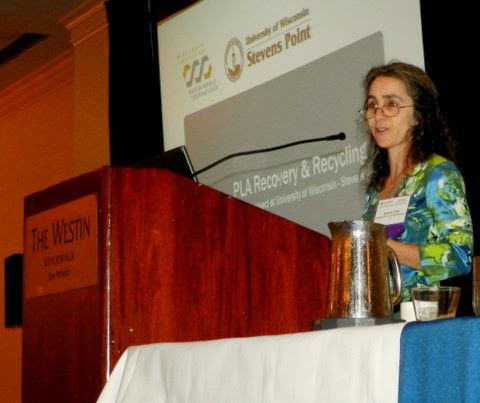
Ei Advisory Council member Brenda Platt with the ILSR opens the Day Two program as the plenary keynote speaker with her Pay Dirt: Composting in America to Reduce Waste, Create Jobs, and Enhance the Soil.

The USZWBC launched the Third-Party Zero Waste Certification Program in early 2013 with Whole Foods' receipt of the first Zero Waste Certifications. In November, Sierra Nevada earned the first Platinum Zero Waste Certificate for reusing or recycling 99.8% of their operation's by-products. For additional information visit the USZWBC Zero Waste Certification page. Day One of the conference program ends with an USZWBC Zero Waste Certification Program Overview by Stephanie and USZWBC president Sue Beets of SBM Management.

USZWBC groupplaque credit resized
Sierra Nevada receives first Platinum
Zero Waste Certification
photo courtesy of USZWBC
On May 6th the USZWBC offers a pre-conference Zero Waste Professional training course for those interested in pursuing Zero Waste Business Associate Certification or to learn more about the USZWBC Facility Certification and the scorecard system. 

Infiltrated within the stellar program is ample networking time to meet fellow attendees | presenters, reunite with industry pals and visit the exhibitor booths. Each conference day begins with a delicious full-service breakfast buffet and the first day ends with a reception. A plated lunch is served each day in the plenary room. The conference is well-balanced with formal educational sessions and relaxed time.

Beyond Ei's conference partner and media sponsor status, Ei Partners are active with the conference via sponsorship, panel presentations and promoting conference attendance. Ei Partners CleanRiver, NatureWorks, Novelis and Orwak are conference sponsors and share their expertise on panels. Bruce Buchan of CleanRiver serves on the Property and Facility Management panel, Doug Kunnemann of Natureworks on the Sustainable Packaging panel, John Gardner of Novelis on the Businesses Leading the Way to Zero Waste, and Mark Lanning of Orwak on the Recycling Refinement panel.

Ei Partners @ the CleanRiver booth
@ the 2012 inaugural conference 
In addition, Ei Supporters Patrick Cuccaro, Affairs to Remember general manager, Tim Trefzer, Georgia World Congress Center Authority director of sustainability, and Michael Cheyne with the Atlanta Airport share their success stories on panels. Ei Friend Lorraine White of M-PASS Environmental presents on the Recycling Refinement panel.


Ei Strategic Allies - Sustainable Atlanta, Institute for Local Self-Reliance, and the Sustainable Packaging Coalition - are active conference hosts, partners, speakers and promoters.  

With ample planning time, the 2014 USZWBC Conference is staged for success along with tremendous industry impact!

Saturday, March 8, 2014

Atlanta Airport Presents a Proactive Approach to Airborne Kitchen Grease

AKG in kitchen exhaust
system ducts
Airborne grease and smoke generated as a cooking by-product are a fire hazard, an environmental concern and costly to clean. Local and national fire safety regulations require commercial foodservice operations to install a kitchen exhaust system to evacuate heat, grease effluent, moisture and smoke from the cooking area. Generally consisting of a hood, baffle filters, ducts and exhaust fan, the kitchen exhaust system must be monitored and maintained in accordance with the codes.

Most kitchen exhaust systems are inspected monthly or quarterly and require a system cleaning due to grease build-up. On average an exhaust system cleaning uses approximately 350 gallons of water along with toxic cleaning agents. In addition, the metal baffle filters are generally cleaned nightly, requiring labor, water and toxic cleaning chemicals. On average 40 gallons of water is used for nightly baffle filter cleaning.


Cover
Feb | Mar 2014
Airport Magazine
In the American Association of Airport Executives' February | March publication Airport Magazine article, Hartsfield-Jackson Atlanta International Airport (ATL) presents a proactive approach to Airborne Kitchen Grease (AKG). The AIRBORNE KITCHEN GREASE: A New Frontier in Sustainability, A simple solution saves tremendous water use, labor and dollars article is in the Airport Magazine Asset Management department.

By capturing the AKG before it enters the kitchen exhaust system the nightly baffle filter and entire system cleanings are significantly reduced. Another cost-savings is the reduction in roof repairs & maintenance due to little to no AKG flowing through the kitchen exhaust system.

Elemental Impact Partner Ellis Fibre developed the patented, disposable Grease Lock Filters (GLF) made from a proprietary blend of fire retardant wool. Installed in front of the baffle filters, GLF capture 90 -  95% plus of the AKG before entering the kitchen exhaust system. The filters are easily replaced when filled with grease.

Grease-laden filter
next to a clean filter
The ZWA Blog article, Zero WATER Waste: more than a goal, a necessity, introduces the foundation of Ei's Water Use | Toxicity Platform along with a GLF overview. Within the Water Use | Toxicity Platform, Ei is creating a Proactive AKG Approach template. In the ZWA Blog article, Airborne Kitchen Grease, a simple solution to a costly kitchen by-product, Ei establishes the four action steps in template development:
  1. Fire Safety
  2. Cost-Savings
  3. Metrics Platform
  4. Filter End-of-Life
For a pictorial account of Ei's AKG template development, visit the Ei FB album, Airborne Kitchen Grease, a costly cooking by-product.

In early 2013 HMSHost - ATL participated in a three-restaurant, eight-week pilot to substantiate the cost-savings experienced by the foodservice operator when using GLF. The Water, Chemical, & Cost Savings in Commercial Kitchens By Using Grease Lock Filters, A Report on Restaurant Pilots is downloadable on the Ei Airborne Kitchen Grease page. Impressed with the pilot results, HMSHost installed GLF in additional ATL concessionaire operations. 

Tim Slaney, HMSHost ATL senior director of operations, provided the following quote for the AAAE article:
“We have had great success using the GLF system—it produces energy and cost-savings, and is good for the environment and for us. We are constantly seeking ways to create efficiencies and minimize environmental impact. The GLF system achieves a cleaner system and improves air quality. We use it at several of our restaurants at ATL.”
Ei GREASE Team meets
with ATL associates
In August 2013 the Ei GREASE - Grease Recycling Alternative Solutions for the Environment - Team met with the ATL sustainability, concessionaire and facilities departments to review the GLF pilot report and strategize on action points. 

Enthusiastic about the potential airport | concessionaire roof repair & maintenance, water, labor, and cleaning cost-savings, ATL embarked upon a campus-wide GLF installation business case justification study. If implemented, ATL will be the first airport worldwide to take a proactive AKG stance.

As documented in the AAAE article, a campus-wide GLF installation would save ATL an estimated 1.1 million gallons of water usage annually. Each of the 80+ concessionaires would experience approximately $7,300 in cost-savings per year. In addition, an estimated 42,000 pounds of AKG would not deposit on ATL roofs nor release into the atmosphere.

From an environmental perspective, the water used for cleaning in the current reactive AKG scenario is laden with grease and toxic cleaning agents when released into grease traps or directly into sewer systems. 

Atlanta Air Quality Image
courtesy of Creative Loafing's Bad air days
AKG released into the atmosphere is harmful to air quality and impacts two of the six EPA National Ambient Air Quality Standards: Ground Level Ozone and Particulate Matter. Note the Metro Atlanta area is not in attainment of these two standards. Ei is in the exploration stage to determine if the AKG air quality impact is significant.  

Dan Hennessy, Applebee’s district manager for Southern California, affirms the sound business case for using the GLF system with his testimonial: “After the simple installation of the GLF, our chain quickly began to see savings in labor, water, and exhaust system cleanings. On average, each of the stores uses about 1.5 cases of GLF per month, and saves about $2,000 per year from the ease of use of the Grease Lock filters.” 

Kudos to ATL for taking an industry leadership role with a proactive approach to AKG. Thank you Michael Cheyne, ATL director of sustainability and asset management, for devoting your February | March  AAAE Asset Management Column to AKG. The article was co-written by Michael and Ei founder Holly Elmore with Liza Milagro, ATL senior sustainability planner, and Jordan Salpietra of Ellis Fibre | GLF substantiating the ATL-specific estimates.

Airborne Kitchen Grease is a new sustainability frontier where ALL WIN: the foodservice operator, the facility, the community and the environment. With Industry leaders like HMSHost and the Atlanta Airport - the busiest airport in the world - at the helm, a proactive AKG approach will spread like wild fire, so to speak!

Friday, January 24, 2014

Airborne Kitchen Grease: a simple solution to a costly kitchen by-product

Airborne Kitchen Grease is a by-product
of culinary operations
Elemental Impact's definition of waste expands beyond material | by-products generated in operations to include resources, specifically water. In the ZWA Blog post, Zero WATER Waste: more than a goal, a necessity, the foundation for Ei’s Water Use | Toxicity Platform is established.

In alignment with an Ei mantra:  Ei determines what could be done that is not being done and gets it done, the Ei Team explores areas of significant corporate water consumption where technologies exist to reduce or eliminate water usage. Equipment investment must be offset by water and other cost-savings with a reasonable ROI – return on investment.

The initial focus is on water reduction in areas where the “spent water” released into sewer systems or other waterways is laden with toxic chemicals. Thus, water use and toxicity are addressed in unison. Airborne Kitchen Grease (AKG) is a perfect starting point for Water Use | Toxicity initiatives.

ATL Airport concessionaire mgr
Kyle Mastin learning about AKG
Airborne grease and smoke generated as a by-product of kitchen operations are a fire hazard, an environmental concern and costly to clean. Local and national regulations require commercial foodservice operations to install a kitchen exhaust system to evacuate heat, grease effluent, moisture and smoke from the cooking area. Generally consisting of a hood, baffle filters, ducts and exhaust fan, the kitchen exhaust system must be monitored and maintained in accordance with the codes.

Most kitchen exhaust systems are inspected monthly or quarterly and require a system cleaning due to grease build-up. On average an exhaust system cleaning uses approximately 350 gallons of water along with toxic cleaning agents. In addition, the metal baffle filters are generally cleaned nightly, requiring labor, water and toxic cleaning chemicals. On average 40 gallons of water is used for nightly baffle filter cleaning.

Ei Partner Ellis Fibre (EF) manufactures a patented, disposable grease filter that is placed in front of the baffle filters. EF's Grease Lock Filters (GLF) collect 90% plus of the kitchen grease particulates before entering the kitchen exhaust system. By eliminating grease build-up in the system, the nightly baffle filter cleaning is generally reduced to weekly; the number of third party contracted kitchen exhaust system cleanings are often required annually, down from monthly or quarterly.


Installed Grease Lock Filter system
For details on the GLF system, visit the ZWA Blog article, GREASE: a new frontier filled with economic & environmental promise .

To maximize impact, Ei is developing a city-wide AKG initiative. Addressing four key areas is the first step in template creation:
  1. Fire Safety
  2. Cost-Savings
  3. Metrics Platform
  4. Filter End-of-Life
Fire Safety:
First and foremost is fire safety. Before GLF approached Ei, fire safety was thoroughly addressed. Made from a patented, proprietary-blend of sheep's wool and other natural fibers, the filter is naturally oil absorbent and flame resistant. The filter composition allows GLF to keep the grease out of the hood and increase restaurant fire safety.

Certified to UL Standard 1046, GLF will not support combustion. Grease collected on the filter may flare-off if excessively heated or subjected to flames; however, when the flame source is removed the filter will self-extinguish and is replaced with a new filter.

GLF is tested, compliant and/or recognized by the following:
Grease accumulation in the
kitchen exhaust system
  • Standard UL 1046/ULC-S649 & UL 710 – Flame Exposure & Abnormal Flare-Up Test
  • NFPA 96 / IFC – Ventilation Control & Fire Protection of Commercial Cooking Operations
  • NSF 2 / ANSI 51 – Food Equipment & Materials-Formulation Review (Sanitation/Toxicology)
  • TYCO – World Leader In Fire Suppression Systems
  • IMC/UMC - Protects Public Health & Safety For All Building Ventilation Design
With fire safety addressed, the next step is to ensure GLF improves a foodservice operator's bottom line.

Cost-Savings:
To substantiate and quantify the water, labor and toxic chemical savings, Ei joined forces with Compliance Solutions International for a three-restaurant, eight-week GLF system pilot. The Water, Chemical, & Cost Savings in Commercial Kitchens By Using Grease Lock Filters, A Report on Restaurant Pilots prepared by Jay Parikh, CSI president is downloadable on the Ei Airborne Kitchen Grease page.

GLF | HMSHost Team day
before the GLF installation
The comprehensive report documents the impressive water, chemical and labor savings experienced by the participating restaurants. In each case, the restaurant’s bottom line improved by using GLF due to reduced cleaning of the baffle filters and the entire kitchen exhaust system.

In addition to the documented labor, water and chemical savings in the report, the facility experiences reduced fire risk and repairs & maintenance due to less grease accumulation within the exhaust system and the roof ventilation area. The community benefits from reduced emissions due to fewer full-exhaust system cleanings by a third party who travels to the kitchen.

Metrics Platform:
Program success is substantiated by quantifiable data. For the GLF system, measurable success is multi-faceted for the foodservice operator, building owner and the community. 

The foodservice operator experiences cost-savings from reduced third party full-system cleanings, labor for baffle filter cleaning, and water usage. Easily quantified, GLF is building a metrics collection platform that calculates and presents the savings in a simple format for the operator.

In addition to single-operator reports, the platform aggregates savings by companies, territories or whatever other filters are added to the system. The intention is to also track the tremendous water savings for a metro area. 

Later template stages will incorporate roof repair & maintenance savings, lower carbon emission from fewer truck miles driven for cleanings, reduced toxic cleaning agents sent to the sewer systems, and improved community air quality due to reduced grease particulates released into the atmosphere from the exhaust system.

Filter End of Life:
Grease-laden filter next to
new filter
GLF is working with Ei Strategic Ally the Institute for Local Self-Reliance on testing the filters for compostability. Current industry standards | certifications for compostability are designed for foodservice packaging, not filters made primarily of sheep's wool. Based on preliminary trials at composting facilities along with an ingredient review, GLF is confident the filters will meet the yet-to-be-determined compostability tests.

The grease collected by the filters is a potential valuable GLF system by-product. In the next months, extraction tests will determine the value compared with the effort required to remove grease from filters as a usable commodity.

With a scenario where all parties benefit - foodservice operator, facility owners, communities and the environment - Ei is developing a strategic plan for a metro-wide GLF installation. Atlanta is the template pilot city.

SFCI Team @ ATL Airport
As the Sustainable Food Court Initiative Airport Pilot, the Atlanta Airport takes a leading role with a potential campus-wide GLF installation. Ei Partner HMSHost participated in the above reference pilot with Pei Wei in the Atlanta Airport International Terminal. Impressed with GLF performance, HMSHost installed the system in additional Atlanta Airport locations.

An Atlanta Airport campus-wide GLF installation is estimated to reduce water usage by 1.1 million gallons per year and on average save each concessionaire $7,500 per year.  

For GLF installation pictorial recaps at the Atlanta Airport, see the Ei FB albums, 02-20-13 Grease Lock Filter Pilot Tour and 04-17-13 SFCI Team Tour - ATL Airport Int'l Concourse.

Airborne Kitchen Grease is a new frontier in sustainability. Water usage reduction is the first quantifiable step followed by eliminating significant amounts of toxic cleaning agents from entering the sewer system. Final steps address the airborne grease particulates not dispersed into the atmosphere, impacting air quality.

ZWA Blog articles will chronicle action taken, success achieved and how challenges evolve into lessons learned. Within frontiers, pioneers develop the most effective paths and create new standard practices. Kudos to the Atlanta Airport and HMSHost for taking the leadership role as Airborne Kitchen Grease pioneers!

Sunday, January 12, 2014

Refining Recycling Practices at the GA Dome

As the Sustainable Food Court Initiative Event Venue Pilot, the Georgia Dome is committed to refining existing recycling practices. In their role as a Founding Zero Waste Zones Participant the Dome built a strong recycling foundation when the program launched in February 2009. Working with the SFCI Team, the Dome is exploring avenues to refine existing practices that increase recycling rates and maximize material value generated at events.

In September Elemental Impact founder Holly Elmore joined Tim Trefzer, Georgia World Congress Center Authority director of sustainability, on a game day recycling tour with the new Falcons Stadium architects. It was an inspiring day to witness solid recycling practices in-place along with opportunities for program evolution. The ZWA Blog article, Winning Recycling Seasons Require Team Work, is recap of the game day tour.

Beginning with the 2012 season, Ei Partner Novelis stepped into the Falcons Recycling Partner role. First action steps included installing two brightly decorated eight-yard recycling dumpsters in the four GWCCA-owned parking lots used as pre-game tailgating venues. For the 2013 season Novelis provided outdoor & indoor recycling bins. The Novelis bins complement the Coca-Cola bins in service for the past years.


SFCI Co-Chair Doug Kunnemann,
Melissa Selem (Ei) & Matt
Bedingfield (Novelis)@ dumpste
With much of the proverbial "low hanging fruit" addressed, the SFCI Team is in a fact finding mode to understand the next best steps on the Recycling Refinement journey. Three areas of exploration include: 1> increased tailgating recycling with a focus on privately owned lots, 2> post-game food waste & compostable products picked from the Dome seating for composting destination and 3> creation of an on-site mini-MRF (materials recovery facility) where recyclable items generated are baled for sale as a raw manufacturing material.

On Sunday, November 10 SFCI Team members toured pre-game festivities on Falcons Landing and tailgating in private and GWCCA-owned parking lots. Since the September visit, the Dome added recycling bag dispensers on the Novelis dumpsters. Most folks are happy to participate in recycling, as long as it is easy!


It appears little to no recycling is in-place at the privately owned tailgate lots. Under Keep Mecklenburg County Beautiful executive director Jake Wilson's direction, the Carolina Panthers tailgate recycling program is a huge success. With the tailgate lots privately owned, Jake orchestrated an outstanding team consisting of public & private entities working in unison towards the common recycling goal. Jake is happy to share his expertise with the SFCI Team; a goal is to replicate the Panther's model for the privately owned lots near the GA Dome. The ZWA Blog article, Panthers Winning Recycling Season, is an overview of the successful program.  

Ei has a strong Charlotte presence and works closely with Jake on many fronts. The IMPACT Blog article, Charlotte Ei Partner Tours, along with the ZWA Blog articles, Bring the Possible out of Impossible, and Scaling Up Composting in Charlotte, NC, document Ei's on-going work in the Charlotte area.


Falcons Game Tour Group
see Ei FB album for names
When complete with the pre-game observation and fact finding mission, the Team walked the GA Dome back & front-of-houses noting the recycling practices in-place. Tim educated the group on current systems along with potential near-term upgrades. Although there are ample recycling bins, strategic placement may be enhanced in several areas including the executive level. 

Recycling bins placed next to trash cans in general yielded a reasonably clean stream. Yet the trash cans often contained PET and aluminum bottles. Additional signage that complements the Dome decor may improve recycling rates.

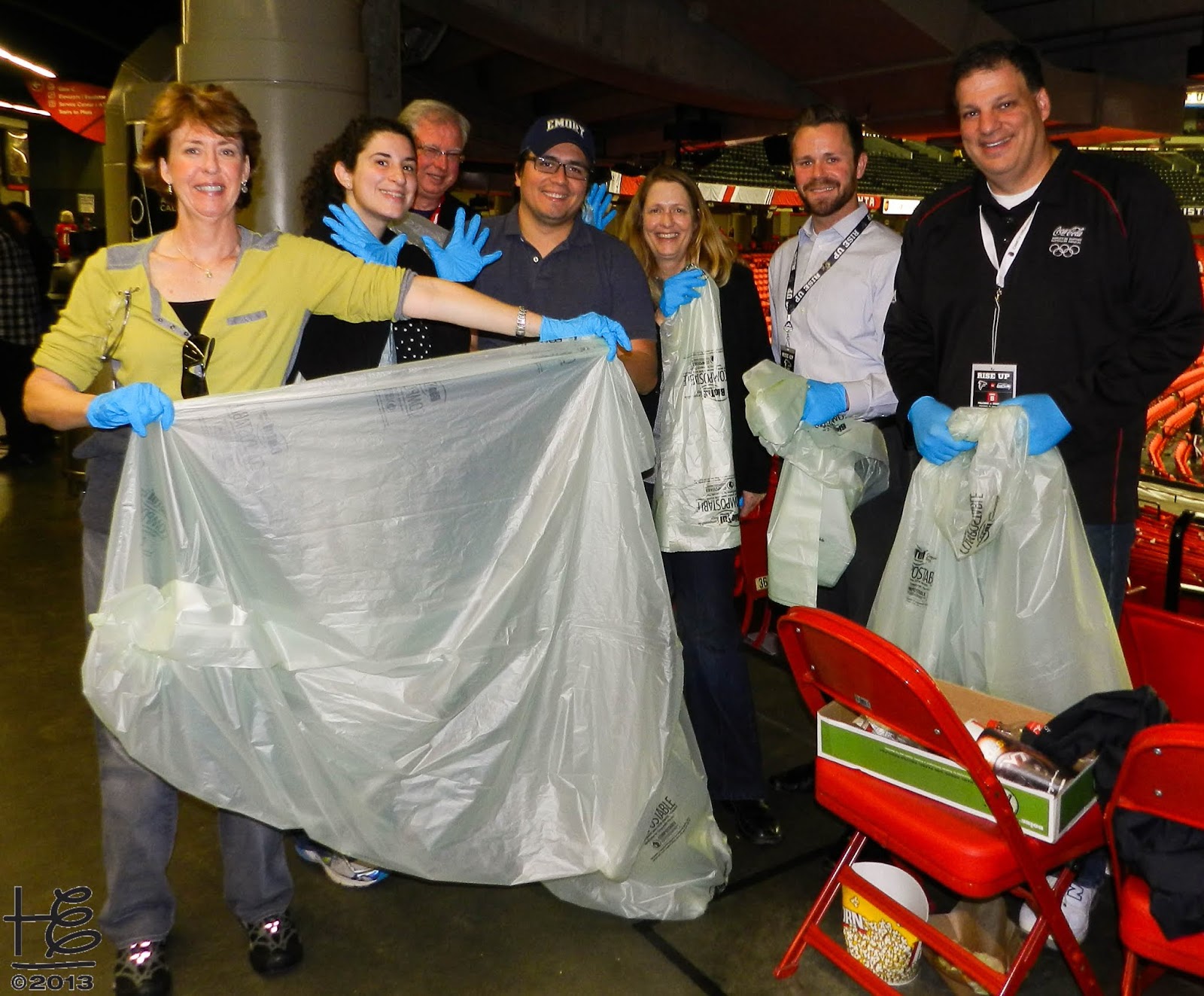
As the game ended several additional SFCI Team members joined the group to pick selected seating sections of food waste and compostable products fans left behind. The group collected 13 bags - 133 pounds of food waste & compostable products - and gained insight for creating a successful post-consumer food waste collection program.


SFCI Team members ready to collect
post-game f&b packaging
Ei Partner Heritage Bag donated a case of their BioTuf Compostable Bags for the food waste & compostable packaging collection. The bags were sturdy and perfect for the job at hand.

Insights during the "bowl picking" included:
  • Though the majority of the food and beverage packaging is compostable, there is more "trash" packaging than anticipated. Condiment containers | wrappers and subcontractor vendor packaging were the majority of contaminants for compost facility destination.
  • Most of the compostable food boxes | trays included a liner - there is confusion whether the liner is compostable.
  • The majority of the collected material was packaging and the bags were bulky, rather than the dense nature of pre-consumer food waste. On average the bags weighed around ten pounds when full.
Doug & Holly collecting bags
for delivery Wilbros
The food waste and compostable packaging bags were stored in the GA Dome loading dock. On Tuesday November 12 Doug Kunnemann, SFCI Co-Chair, and Holly met Tim at the Dome loading dock to transport the food waste bags to the Wilbros Organics & Biofuels food waste composting facility in Toccoa, GA. The Wilbros folks agreed to monitor the decomposition of the food waste bags, take pictures during the process and report results to Ei. Upon delivery, the Dome material was placed at a windrow end for easy monitoring.

According to Keaton Thompson, Wilbros compost operations manager, the food waste, packaging and bags immediately began the decomposition process, reaching 138 degrees within 72 hours. Ten days later the windrow temperature reached 146 degrees and decomposition was clearly visible. By December 3 the Dome material was well on its way to transforming into valuable, nutrient-rich compost.

Current bowl picking practices include collecting PET and aluminum bottles in a blue recycling bag with the remainder of the material collected in a black trash bag. The blue bags are placed in the recycling compactor for transport to Waste Pro's local MRF where the material is separated, baled and sold in the commodities market.

Pratt Tour Group
Each Falcons game approximately 35,000 programs and 140,000 promotional flyers are distributed among the seats. The majority of the valuable fiber is landfill destined. Ei Partner Pratt Industries operates a cardboard mill within 20 miles of the Dome where cardboard is made from 100% recycled material. In June 2013 Ei hosted a Pratt Mill Tour for Tim and Michael Cheyne, Atlanta Airport director of asset management and sustainability, to learn about the local option for paper | fiber generated at their respective facilities.  Note the Atlanta Airport is the SFCI Airport Pilot.

Novelis Tour Group
Within the vision of on-site source-separation is selling recyclable items as a raw material to local manufacturing operations. The Novelis aluminum recycling plant located in Greensboro, GA is another local option for valuable material generated at Dome events. In early October 2013 Tim and Holly toured the Greensboro plant to experience the aluminum recycling process.

For a pictorial recap of the GA Dome's pioneering efforts in Recycling Refinement, visit the Ei FB album, Refining Falcons' Recycling Programs.

Integral to Recycling Integrity - maintaining maximum material value with minimal energy expended - is on-site source separation and local material destination. The GA Dome along with its sister facilities the GA World Congress Center and Centennial Olympic Park are in the initial steps of refining their recycling practices to a program that maximizes material value, uses minimum energy and improves the bottom line.