Search This Blog

Wednesday, February 19, 2020

A Decade of Impact: History & Background

The first in a three-article series celebrating Ei's ten-year anniversary.

On February 5 Elemental Impact (Ei) celebrated ten years of making an impact in an array of industries and communities. In 2010 Ei was incorporated as a 501(c)3 non-profit to serve as the home for the Zero Waste Zones (ZWZ.)

Beginning with the ZWZ, Ei initiatives epitomized the following mantra:

Ei is a creator, an incubator. 
Ei determines what could be done that is not being done and gets it done. 
Ei brings the possible out of impossible. 
Ei identifies pioneers and creates heroes.

Ei Founder Holly Elmore's eclectic career path was at the foundation of the successful 2009 ZWZ launch by the Green Foodservice Alliance (GFA.) Holly founded the GFA in 2008 within the Georgia Restaurant Association (GRA) umbrella.

A valuable, eclectic career path
After nearly seven years in the corporate arena as an auditor and CPA at Arthur Andersen followed by Controller for the Southeast Division at Trammell Crow Residential, Holly followed her entrepreneurial spirit. In late 1988 Holly created Executive Catering & Events (EC&E), a prominent corporate-catering company, and later operated two restaurants.

For eight years, EC&E was the exclusive caterer for the Atlanta German Consul General and catered 100% of the German dignitary events during the 1996 Centennial Olympics hosted in Atlanta. Additionally, EC&E was the preferred caterer for the Canadian Consul General for six years, the French American Chamber for five years, and many other international government offices and organizations. Beyond the international market, EC&E maintained a high-profile corporate clientele.

In the early 1990's Holly served on the inaugural Atlanta Restaurant Council (ARC) Board; the ARC eventually segued into the GRA, a state affiliate of the National Restaurant Association (NRA.) Holly's in-depth foodservice-industry connections and expertise were instrumental to the successful ZWZ launch as well as the Chefs' Tour & Dinner Series.

Holly & Will at WOP
Once EC&E's fifteen-year tenure was complete, Holly made a commitment to create a flexible and fluid lifestyle where she worked from home on humanitarian-focused endeavors with reasonable travel. As a subcontractor, Holly served as the Wine South Sales & Marketing Director. Wine South was the premier wine event in the Southeast and owned by The Wine Report.

While at Wine South, Holly met Will Harris, fifth-generation proprietor of White Oak Pasture (WOP). During this time frame, Will was transforming his South Georgia cattle ranch into a regenerative agribusiness with numerous livestock species raised holistically and harvested respectfully on the farm.

The 2011 IMPACT Magazine article, White Oak Pastures - Dignity & Respect @ Its Core, articulates WOP's history and transformation into an impressive regenerative agribusiness. Holly's close relationship with WOP was instrumental in numerous GFA and Ei successes.

Post-Wine South, Holly served as the Director of Sales for several years at Restaurant Forum, the official publication for the GRA. The Restaurant Forum affiliation led to Holly working as a GRA subcontractor. During her GRA tenure, Holly created the North Georgia Chapter and the Off-Premises Catering, the Chefs, and the Local Sustainable & Green (LS&G) Round Tables. Additionally, Holly served as the official liaison between the GRA and the Atlanta Chapter of the American Culinary Federation (ATL ACF.)

The LS&G Round Table was the precursor to the GFA.

From Round Table to Movement
In 2006 - 2008, the local, sustainable food movement was in its infancy. For the second LS&G Round Table meeting hosted at the Four Seasons a crowd of 100+ guests attended, including prominent chefs, local farmers, then Deputy Commissioner of the Georgia Department of Agriculture Terry Coleman, and associates from Emory, the Center for Disease Control and the City of Atlanta.

As the meeting closed, GRA CEO Ron Wolf announced the LS&G Round Table was more than a round table; it was a movement. Within weeks, the GFA was formed under Holly's leadership.
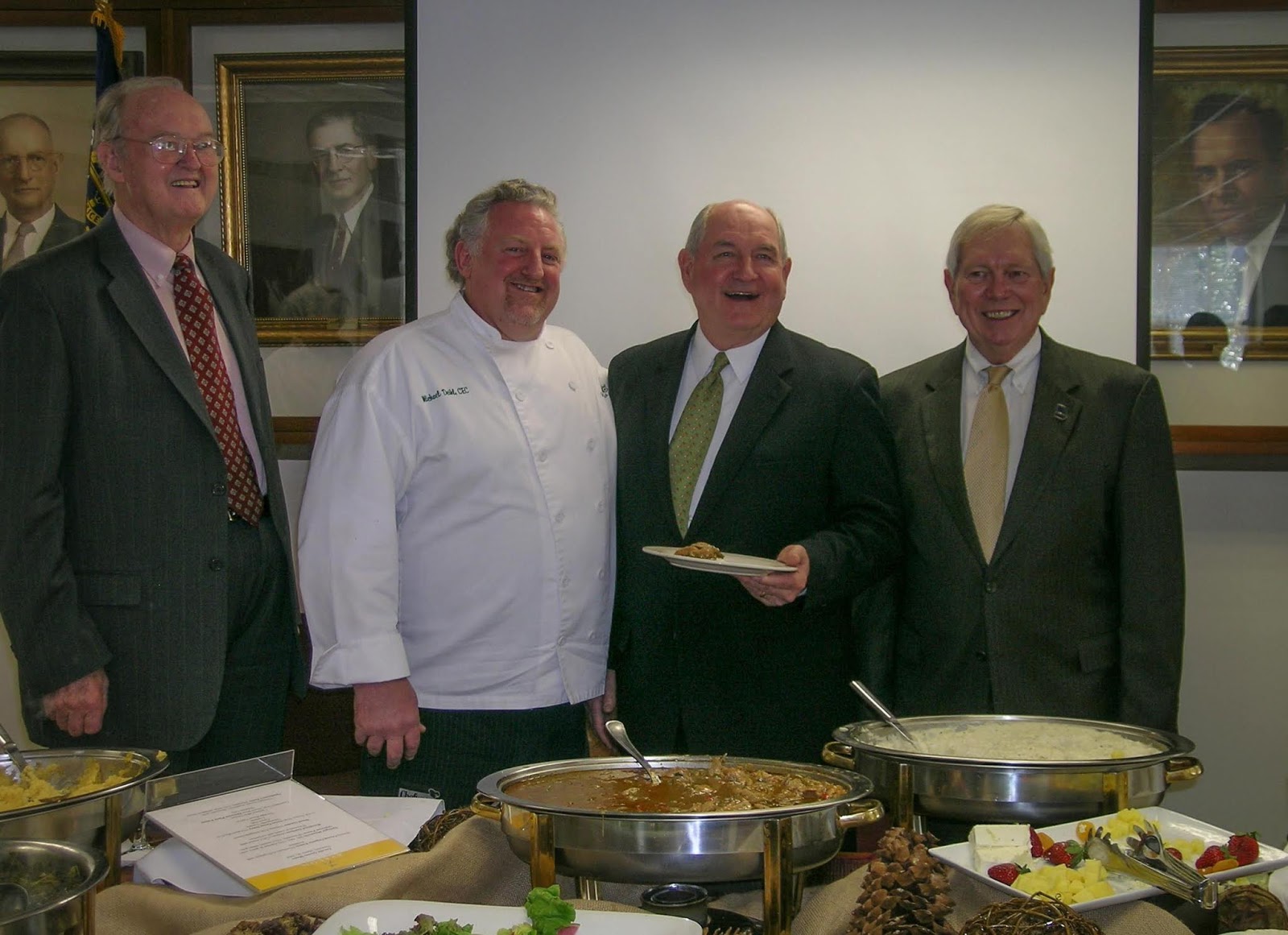
Dept of Ag Commissioner Tommy Irwin,
Chef Michael Diehl, Governor Sonny
Perdue, Deputy Commissioner
Terry Coleman @ luncheon
With her strong chef connections, Holly assisted with the inaugural Georgia Grown Show hosted by the Georgia Department of Agriculture. For several years, Holly worked closely with Terry and his team on building the Georgia Grown program along with other endeavors. During this time frame, Holly introduced the Georgia Organics team to Terry and his associates.

In recognition of the Georgia State Legislature Resolution honoring the joint accomplishments of the GFA | GRA, Georgia Organics, and the ATL ACF, the Georgia Department of Agriculture hosted a meet and greet luncheon for state legislatures on March 20, 2008. In addition to a strong legislature attendance, Governor Sonny Perdue joined the festivities. Currently, Sonny Perdue is the U.S. Secretary of Agriculture.

In his then capacity as President of the Georgia Agribusiness Council, current Georgia Department of Agriculture Commissioner Gary Black was an active member of the GFA Producers Task Force Advisory Council. Thus, Ei maintains a strong connection to the Department of Agriculture, which is beneficial to Ei Era of Regeneration projects.

Mere weeks after forming, the Green Foodservice Alliance co-hosted the inaugural Green Restaurant Revolution - A Conversation with Ted Turner event at the The Carter Center. From the official  press release:
Ted Turner 
On Monday, March 31, over 130 chefs, restaurateurs and industry partners attended the Green Restaurant Revolution – A Conversation with Ted Turner, hosted by the Georgia Restaurant Association and the new Green Foodservice Alliance. This special breakfast featured Ted Turner - environmentalist, media entrepreneur, and the founder and chairman of Ted's Montana Grill, as well as his business partner, George McKerrow, founder, president and CEO of Ted’s Montana Grill.
The discussion was moderated by 11Alive News reporter Denis O’Hayer and focused on ways members of the hospitality industry can work together to impact the future through environmental stewardship and local sustainability. Proceeds from the event benefit the new Georgia Restaurant Association Scholarship for Georgia State University's Cecil B. Day School of Hospitality.
March 2008 was an empowering month for the newly formed GFA. 

Chef s' Tours & Dinners
In July 2008 the GFA embarked on orchestrating the Chefs' Tours of local farms, dairies and fisheries. The tours were in partnership with the ATL ACF. As the tours aligned with the recently launched Georgia Grown program, the Georgia Department of Agriculture was supportive of and participated in the tours.

As the local & sustainable movement was in its infancy, the tours were novel and a treat for all involved. ... and what a lovely avenue to celebrate Atlanta Chefs as well as local cuisine!

White Oak Pastures
The July 29, 2008 WOP Chefs' Tour was the first tour and celebrated the new onsite abattoir (slaughterhouse). WOP cattle are bred, born, live and gift their lives on the farm without the stressful transport to a USDA-approved slaughterhouse.

WOP Chefs' Tour group photo
Photo credit: Christy Cook
Along with his daughter Jenni Harris, Will was the most gracious host. After an overview tour of the fields to understand the farm practices and meet the cattle, the chefs witnessed the humane-slaughter process. No cameras were permitted during the slaughter.

Afterwards, Buckhead Beef master butcher Manny Vizcaino, along with WOP staff, broke down a side of beef into usable cuts. The chefs were enthralled with the process.

Will treated the chefs to a wonderful lunch where stellar hamburgers were the star and ample beer and other adult beverages flowed.

After a series of group photos, the chefs boarded the bus for the infamous return ride to Atlanta. What happened on the bus stayed on the bus! Yet the photo section gives a glimpse of the fun times enjoyed by all!

Manny breaking down
a side of beef

Photo credit: Christy Cook
The Holly Elmore Images (HEI) album, Chefs' Farm Tours: White Oak Pastures, gives a pictorial recap of the fabulous day. Photos are compliments of Christy Cook.

When the FB album published recently, Lanier Islands Senior Food & Beverage Director Michael Klein validated the important role the GFA played in the Chefs' Tours with his comment:
"That was a great day, Holly! Just a perfect melding of chefs, restaurateurs, advocates, enthusiasts and farmers. Thanks for all you continue to do to support all of us."
Following the WOP Chef's Tour in July, the chefs reunited in the fall for an amazing dinner hosted at the Le Cordon Bleu College of Culinary Arts (LCB) facility in Atlanta. The dinner was presented by Restaurant Forum, the ATL ACF, and the GFA.

Chefs Mihoko Obunai | Joe Truex (repast), Robert Gerstenecker (Four Seasons) and Michael Diehl (East Lake Golf Club) collaborated on a phenomenal menu sourced with local produce and protein.

To celebrate the summer tour, Robert prepared WOP beef cheeks braised in Silver Oak Cabernet Sauvignon - it was Divine!

Diners included over 30 prominent chefs and a guest along with sponsor and host representatives. Culinary students assisted the chefs in kitchen prep, entree plating, and serving the prestigious crowd.

Produced by Restaurant Forum, the 2008 Chefs' Dinner - WOP Tour video is an excellent pictorial recap of the amazing dinner.

Sweet Grass Dairy
For the 2009 farm tour, the chefs chose to visit Sweet Grass Dairy in Thomasville, GA where the livestock gifted their milk, versus their lives, for the farm's superb Georgia Grown products.

Sweet Grass Dairy is a South Georgia award-winning dairy where cheeses are handcrafted and distributed nationally.

Chef Micah Willex
with goats
Photo credit: Suzanne Welander
After meeting the friendly, free-ranging goats, owners Jessica and Jeremy Little treated the chefs to an educational tour of the dairy operations and cheese-making process. Other South Georgia farmers who provide various products and protein for the chefs joined the day's festivities.

Prior to departing back to Atlanta, the chefs enjoyed a lovely lunch made with local ingredients, including ultra-local cheese.

The Chefs' Sweet Grass Dairy Tour was a fantastic day of education, fun and simple joy. The HEI album, 2009 Chefs' Tour: Sweet Grass Dairy, gives a pictorial recap of the fabulous day. Photos are compliments of Rachel Keller and Suzanne Welander.

Following the spring Chefs' Tour of Sweet Grass Dairy, the chefs along with friends and sponsors reunited at LCB for a festive Chefs' Dinner featuring local food sources, amazing wine, and perfect camaraderie. The dinner format was similar to the 2008 dinner.

Another stellar team of chefs collaborated on a five-course dinner plus appetizers hosted at LCB and presented by Restaurant Forum, the ATL ACF, and the GFA. The team included Hector Santiago (Pura Vida), Gerry Klaskala (Aria), Kevin Rathbun (Kevin Rathbun Steak), and Thomas Numprasong (Canoe.)

In honor of the spring Chefs' Farm Tour, Sweet Grass Dairy donated a variety of their lovely cheeses for a delightful dinner course.

Chefs Michael Deihl &
Kevin Rathbun
Photo credit: Leonardo Ruscitto
During the closing remarks with the culinary students, the brave student Karie Brown Weinreich​ BUSTED Kevin for breaking his sauce. It was perfect and delivered with superb humor! Thomas was impressed with Karie and subsequently hired her as a pastry chef at Canoe!

The HEI album, 2009 Chefs' Dinner, gives a pictorial recount of the dinner compliments of event photographer Leonardo Ruscitto.

The Restaurant Forum video, 2009 Chefs' Dinner, celebrates the spectacular event.

Savannah
In April 2010, Ei continued the GFA Chefs' Tour & Dinner Series with a final event in Savannah, GA. Rather than a one-day tour followed by a dinner several months later, the Savannah event was a two-night affair filled with a day of tours and dinner at a local restaurant.

University of Georgia (UGA) Marine Extension Service Seafood Specialist Tori Stivers inspired the Savannah tour in her conversations with Holly regarding oyster-shell recycling. From these conversations, the Savannah Chefs' Tours & Dinner was created with strong support by the UGA Marine Extension Services.

Chefs digging for clams
Photo credit: Leonardo Ruscitto
In the morning, UGA marine biologists hosted the chefs on the Bulldog Research Vessel where the chefs trawled for shrimp and other marine wildlife. Later in the day, the chefs got "down & dirty" as they dug for clams on the Savannah Clam Company's leased mud flats. Harvested clams, as well as shrimp from the morning adventure, were served at an astounding evening dinner hosted at Local 11Ten.

The HEI album, 2010 Savannah Chefs' Tours & Dinner, gives a pictorial recount of the dinner compliments of event photographer Leonardo Ruscitto.

The Chefs' Dinner & Tour Series was integral to the GFA's many successes and accomplishments. Relationships made while working closely with the chefs was key to the February 2009 ZWZ launch as well as to important work within the Ei Era of Regeneration.

Green Foodservice Alliance
While projects within the GFA Producers Task Force partnered with Georgia Organics, the Georgia Department of Agriculture, and/or ATL ACF, seminars, pilots, and initiatives within the Green Task Force were in partnership with the Georgia Department of Natural Resources Sustainability Division (GDNR SD) and the U.S. Environmental Protection Agency Region 4 (EPA R4). Additionally, the GFA worked closely with the Georgia Recycling Coalition (GRC) and Atlanta Recycles (AR.)

In March 2009 Gas South validated the GFA's important work with a $10,000 Sapling sponsorship. Additionally, Gas South General Manager Business & Government Markets Chris Coan chaired the Energy & Technology Committee.

Website
Via Coca-Cola's sponsorship and a powerful team of in-kind partners, a simply gorgeous, highly functioning website was launched to document and showcase GFA's important work. Lee Thompson with Thompson Creative spearheaded the image design and creative component. While Maurgood crafted the content strategy, Holly wrote the site copy and navigation outline.

The site's main components were Water, Energy Efficiency, and Recycling. The ZWZ as well as the GFA Green Certification program were housed in their own site sections. It was truly a magnificent website that was ahead of its time.

Seminars
Throughout 2009 U.S. Foodservice and Royal Cup Coffee sponsored a series of three GFA seminars introducing new-found sustainability topics within the hospitality industry. The seminars were in partnership with the GDNR SD and EPA R4 and supported by the City of Atlanta, Atlanta Conventions & Visitors Bureau, Georgia Hotel & Lodging Association, GRA, GRC and AR.

Seminars were hosted at the Atlanta Community Food Bank (ACFB) and the cost was a donation to the ACFB. The three seminars were well attended with a strong cross section of industries represented. Below are the three seminars:
Stimulate Energy Savings
Seminar invitation
  • Waste or Product, February 24, 2009: With a permitted food-composting facility in Georgia, composting of organic residuals is now a viable option for the foodservice industry.  Attend the seminar and learn from the experts the options available to compost food residuals.
  • CARBON WHAT?, June 17, 2009: Learn from the experts the answers to these questions: What is carbon's impact on the environment? How is carbon generated? What is a carbon footprint? How do I calculate my carbon footprint? What are carbon credits? How do I generate carbon credits? Should I purchase carbon credits?
  • Stimulate Energy Savings, October 29, 2009: Energy Savings Abound. What tax advantages and other benefits are available to your business for green efforts? How can energy-efficient design help you save on BOTH utility bills and tax bills? How to design a plan to exchange into energy-efficient buildings, equipment and fixtures? What state and federal grants are available based on the ARRA? Learn the answers to these questions and much more!
GFA Green Certification
Working closely with GFA Board member Debby Cannon, Georgia State University School of Hospitality Director, along with program manager Marina Bryant and Ted's Montana Grill, the GFA Green Restaurant Certification was launched in the fall of 2009.

Fifth Group's ECCO restaurant located in Midtown was the first restaurant to receive the green certification. As a strong GFA supporter, ECCO hosted the ZWZ-formation meetings in their dining room prior to service hours.

ZWZ Launch
In February 2009, the ZWZ launched in Atlanta at a press conference lead by Stanley Meiburg, Acting Regional Director of the EPA R4. With impressive media responses, Atlanta received national recognition as a pioneer city in sustainability. The Ei Media page details the many press listings, including a CNN story and New York Times front-page article.

The story begins in the summer of 2008 when Atlanta lost a convention to another city as the client perceived the other city “greener.” A convention-driven city, Atlanta was ready to embrace “green practices” in the downtown-convention district; businesses pledged to implement zero-waste initiatives. Working in collaboration with AR, the GRC, the GDNR SD and the EPA R4, the ZWZ Criteria was developed, participants recruited, and the ZWZ-Downtown Atlanta launched. Laura Turner Seydel was the ZWZ Chair.

The formal ZWZ definition: a collective gathering of community working together on changing current disposal methods of consumed products.

ZWZ Team at the
ZWZ-Buckhead launch
A zone was a defined geographic area or a foodservice category with unique characteristics impacting ZWZ Criteria. Territory zones partnered with a local business association and mirrored the association’s district; territory zones created route density for ZWZ suppliers. A category example was the Off-Premises Caterers zone where food is transported to an off-site location.

The foodservice industry, the second largest private-sector industry, served as a catalyst for change in standard corporate-operating practices. Government, non-profit, trade association and private-enterprise stakeholders developed an ACTION plan that made good business sense for the entire value chain, including the community and the environment.

The ZWZ goal was to divert the maximum amount of recyclable items and organic matter from landfills and back into the production cycle.

ZWZ Participants pledged to implement and maintain the following criteria:
  • Spent grease collection for the production of bio-fuel.
  • Common recyclables (cardboard, paper, glass, plastic, and metals) collection for recycling.
  • Excess food donation in accordance with the Good Samaritan Food Donation Act.
  • Food residuals from preparation | service and excess food not compliant with the Food Donation Act collection for composting or other state-permitted destinations.
In addition to the inaugural downtown zone, in 2009 ZWZ were launched in the Midtown and Buckhead business districts as well as with Off-Premises Caterers.

The Turner Foundation funded the ZWZ with a $10,000 grant in the fall 2009.

Awards
As an industry forerunner with the ZWZ launch, the GFA received numerous awards in 2009 including Atlanta Business Chronicle Environmental Awards Finalist, Industry Honoree at the Bauder Black Tie Design Show and Portfolio Exposition, and ATL ACF Chapter Recognition at the annual gala.

Strengthening OSWER Partnership Award
The U.S. EPA presented the ZWZ Atlanta Team with the Strengthening OSWER Partnership Award at a September 30, 2009 joint EPA and U.S. Composting Council luncheon. OSWER stands for The Office of Solid Waste and Emergency Response.

The award was for demonstrating extraordinary cooperation, collaboration and support in strengthening a public/private partnership that is diverting a tremendous amount of recoverable products from landfills and supports the city of Atlanta in developing marketing edge for future convention business.

Plaques and certifications were presented at the luncheon. 

2009 GRACE Innovator of the Year Award
GFA General Counsel Charles Hoff &
Holly at the GRACE Awards
Photo credit: Leonardo Ruscitto
On November 30, 2009 Holly was honored at the 2009 GRACE Gala with the Innovator of the Year Award. GRACE Awards are the GRA Crystal of Excellence Awards.

The Innovator of the Year is selected by industry peers and is a visionary leader who demonstrates exemplary talent and promise for the future in the foodservice industry. The ZWZ as well as the Chefs' Tour & Dinner Series were major contributors to Holly’s prestigious award.

Restaurant Forum featured full-page articles on each GRACE Award category winners, including the 2009 Innovator of the Year Award. Filmed by Leonardo Ruscitto, Holly's acceptance speech is recorded in the 2009 GRACE Awards video.

New Beginnings
On December 23, 2009, Holly was informed that the GRA Board found great value in the GFA and would continue to support the organization. Yet, the ZWZ did not align within the GRA parameters; Holly could take the ZWZ and depart the GRA. 

Thus, the doorway opened for the formation of Elemental Impact, a 501(c)3 non-profit independent of the GRA. Thought startling as the time, the GRA's decision proved highly beneficial and maximized the ZWZ impact.

While compiling FB albums to document GFA activities for this article, Holly shared memorable images on social media.  Contributors to the many GFA successes shared powerful commentary via post comments.

Suzanne Welander, Georgia Organics Marketing Director during the GFA days, wrote, 
Great to see Ei owning all of that excellent groundwork that's benefited so many.
The HEI FB gallery series, A Decade of Impact: history & background, gives a pictorial recount of the empowering GFA work and events that built a solid foundation for Ei's formation.

The two sequel articles, A Decade of Impact: Era of Recycling Refinement and A Decade of Impact: Era of Regeneration & Beyond continue the Ei ten-year anniversary celebration by chronicling Ei successes, triumphs, and accomplishments.

Sunday, January 19, 2020

Beyond recycling plastics: elimination of single-use plastics

With the intention of reducing litter, waste, and the use of environmentally harmful products, the City of Berkeley, California enacted the phased-in Berkeley Single-Use Foodware and Litter-Reduction Ordinance. Emphasizing a shift from single-use foodservice products to reusable cups, plates, bowls, and flatware, the ordinance impacts the gamut of foodservice operators.

Ordinance provisions
The ordinance is enforced one year after the effective date with potential exemptions for proven hardships.

Phase I (effective March 27, 2019) is a first-step in waste-reduction and contamination prevention. Accessory disposable foodware items must be provided upon request only, rather than openly available at stations. Examples of accessory disposable foodware items include straws, stirrers, napkins, utensils, condiment cups/packets, cup sleeves, tops, lids, spill plugs, and other ancillary products.

Compost sign available
for download
Additionally, prepared food vendors that allow self-bussing must provide color-coded receptacles for customers to separate their recyclables, compostables, and landfill waste. The ordinance is specific on color-coding to create consistent bussing stations; recommended signage is available for download.

In Phase 2 (effective January 1, 2020) all single-use, disposable food and beverage (f&b) products must be certified compostable and be free of intentionally added fluorinated chemicals. In addition, prepared food vendors must charge customers $.25 for disposable cups; the charge must be clearly identified on menus and listed separately on receipts.

Within food-safety standards, the operator may refuse to fill unsuitable or unsanitary cups provided by customers

With Phase 3 (effective July 1, 2020), all in-house dining f&b must be served on reusable (durable/washable) foodware. Exceptions include certified compostable paper tray/plate liners, paper wrappers, napkins, and straws and recyclable aluminum foil for wrapping items such as burritos. The ordinance requires operators to maintain on-site cleaning and sanitation facilities or contract with off-site cleaning services.

Consumer support for the ordinance is showcased in the January 5, 2020 The Guardian article, The California city that wants to eliminate disposable coffee cups.

The Berkeley ordinance is a solid, strong step in addressing the prolific single-use plastic pollution wreaking havoc on the planet.

A plastic-trashed planet
The October 2019 RiA Magazine article, Plastics: a double-edged sword, articulates plastics history | development and how in a mere 70 years humans infiltrated every nook & cranny of the Earth with micro and nanoplastics. The article opens with how the August 1955 Life magazine article Throwaway Living essentially announced the inauguration of single-use plastic for common household use.

While early plastic usage related to the manufacturing of durable goods, in the 1950's single-use plastic packaging and products were introduced; thus, the onset of plastic pollution.

Humans essentially trashed the planet with prolific plastic pollution that now inhabits every nook and cranny of the Earth. As discovered in prominent research, macro and nanoplastic pollution is prevalent from the arctic snow caps to the depths of the oceans and everywhere in between. Scientists are merely beginning to study the health ramifications of humans, animals, plants and microbial life literally breathing, eating and drinking plastics in its macro, micro and nano forms.

In empowering leadership roles, global non-profit organizations are working to bring the Earth back to a healthy, balanced state. The non-profits are educating on the current scenario, working to stop plastic pollution, creating new manufacturing paradigms, and much more. Below are several examples:
Plastic pollution on a remote beach
  • 5 Gyres continues to educate on the magnitude of plastic pollution in our oceans and beyond. 
  • The Plastic Pollution Coalition works diligently to stop the deluge of plastic pollution with campaigns to eradicate single-use-plastic consumption.
  • The Ellen MacArthur Foundation's New Plastic Economy intends to transform manufacturing design and protocol via two new industry standards: 1> products are made of 100% post-consumer recycled materials and 2> products are designed for reuse with company-sponsored programs making reuse simple, easy, and convenient for the consumer.
A shift in the current disposable culture is necessary to prevent the continual deluge of plastic pollution within our soils, atmosphere, oceans, waterways, and the human-food chain.

Elimination of single-use plastic
GreenBuild purified
water station
While documenting the zero-waste practices at the 2019 GreenBuild International Conference and Expo (GreenBuild) hosted at the Gold LEED-Certified Georgia World Congress Center Authority (GWCCA), the largest LEED-Certified conference center in the world. it was inspiring to witness solid zero-waste practices executed at the event. Beyond the Three R's - reduce, reuse, recycle, GreenBuild focused on reuse, reduction, and elimination of waste.

Via clear communication in contracts and registration documents, exhibitors and attendees were expected to bring reusable beverage containers; no single-use beverage containers were permitted on the showroom floor. Bartenders were instructed to not give attendees empty, compostable wine cups for use at the water stations. At the USGBC booth, complimentary steel cups were handed out with the slogan "Better buildings are our legacy."

Throughout the the exhibit hall, the GWCCA provided purified water stations with five-gallon water bottles on easy-to-use dispensers.

There was nary a single-use plastic water or beverage bottle in sight within the show.

The RiA Magazine article, GreenBuild walks the zero-waste talk, showcases the stellar reduce, reuse, and elimination practices at the event.

KSU Dining Services
reusable to-go containers
While touring their operations, it was inspiring to learn of Kennesaw State University (KSU) Dining Services' reusable plastic-container system for take-out orders. With incentives to return the reusable containers, there are minimal "lost" containers in the successful program that eliminates single-use to-go containers.

In the previously mentioned The Guardian article, The California city that wants to eliminate disposable coffee cups, author Erin McCormick features several for-profit programs designed to assist foodservice operators to adhere to the new ordinance provisions.

With the Vessel reusable cup program, customers "borrow" chic stainless steel cups for up to five days free-of-charge. Vessel signage includes the copy: GET IN ON: THE REUSABLE REVOLUTION.

While working on Sustainable Food Court Initiative pilots during the Era of Recycling Refinement, Elemental Impact (Ei), along with Ei Strategic Ally Institute for Local-Self Reliance, always recommended the use of reusable f&b packaging where practical.

Compostable packaging concerns
With their ground-breaking ordinance, Berkeley opened the door for main-stream media coverage on the evolution from recycling to elimination of single-use products.

Originally published on Civil Eats, the Eater January 15, 2020 article, The Dark Side of ‘Compostable’ Take-Out Containers, Plastic to-go containers are bad, but are the alternatives any better?, announces the Berkeley ordinance and addresses concerns related to the shift to compostable f&b packaging.

The below concerns are summarized from the article:

1> compostable f&b are single-use and often create unnecessary waste.

2> there are limited food-waste composting sites that accept compostable packaging. More facilities are refusing to accept compostable packaging due to rampant contaminants in many post-consumer food-waste streams. Contaminants include simple trash as well as petroleum-based plastics.

An unlabeled exhibitor-provided cup
generated 
rash at a zero-waste event
3> unless clearly labeled, compostable plastic cups & other products resemble petroleum-based plastic items. It is difficult to impossible for compost-facility workers to sort out petroleum-based plastic from the food-waste stream. Cedar Grove, a major Seattle composting company, spends over $5 million a year removing plastic bags, forks, and spoons from its compost.

4> compostable products on their own do not make compost; often, the post-consumer food-waste stream is composed almost entirely of single-use compostable products with minimal nitrogen-based food. Thus, the necessary carbon | nitrogen-ratio for compost is unbalanced.

5> compost made with compostable products in the feedstock cannot be sold to organic farms. The National Organic Board classifies compostable packaging as synthetic material, which are not permitted on certified organic farms.

6> according to the Oregon Department of Environmental Quality (DEQ), “the fact that something is compostable is a useless predictor of environmental impact.” A DEQ life-cycle study found the production and use of compostable materials (and composting them) was found to result in higher environmental impacts than that of either non-compostable materials, or compostable materials treated via recycling, landfilling, or incineration.

It is important to evaluate the use of compostable f&b packaging from a holistic perspective, including its end-of-life and complete life-cycle impact.

Though the new Berkeley ordinance is groundbreaking in the public realm, environmental non-profits and crusaders are long-time reusable f&b packaging proponents. Back in November 2010, environmental crusader Aaron Williams produced The New Green Order video. The short video educates corporations on how reusable coffee-cup programs in the office are environmentally and economically sound.

Counterpoint: compostable packaging | reusables
Though the above concerns regarding compostable packaging are overall valid, there are other important perspectives to consider before making purchasing decisions or creating city ordinances.

The DEQ life-cycle on compostables did not seem to address the impact of plastic pollution when disposable packaging is improperly disposed of and/or simply trashed as litter. As well documented in the previously mentioned Plastics: a double-edged sword article, plastics fragment and disintegrate into micro and nanoplastics. It is well proven that microplastics often kill wildlife when consumed and nanoplastics may segue through cell walls into animal flesh or plant fiber.

Reusable glass cup with a
hay straw at a botanical garden
Compostable packaging will eventually decompose, versus fragment, into harmless chemical compounds without the potentially toxic compounds inherent within some plastics.

Though large establishments may benefit economically by shifting from single-use to reusable serviceware, smaller operations may experience a financial and space drain. Additional financial burdens include the reusable serviceware investment, storage area required for the inventory, and the labor, supplies, and equipment necessary for cleaning and sanitizing the items.

Within the cleaning and sanitizing systems, there are also environmental costs related to the incremental water and energy used to maintain food-safety standards.

Bottom line: the time is NOW to eliminate the prolific single-use plastics integrated within our daily lives. In addition to f&b packaging, single-use plastics are common place in household items (laundry detergent, shampoo etc.), vehicle maintenance (motor oil, antifreeze etc.) and beyond.

As an evolving industry, zero-waste best practices are a work-in-progress. National leaders like the City of Berkeley with their bold ordinance are necessary to vet viable solutions for eliminating daily consumption of single-use plastic. Solutions must benefit businesses, the community, and the environment.

Sunday, January 12, 2020

GreenBuild walks the zero-waste talk

In late November 2019, a global entourage of prominent industry professionals converged on Atlanta for the annual GreenBuild International Conference and Expo (GreenBuild) hosted at the Gold LEED-Certified Georgia World Congress Center Authority (GWCCA), the largest LEED-Certified conference center in the world.

GreenBuild is the biggest annual event for green-building professionals worldwide to learn and source cutting-edge solutions to improve resilience, sustainability, and quality of life in our buildings, cities, and communities. A U.S. Green Building Council (USGBC) event, GreenBuild aligns with the USGBC mission of market transformation through its LEED green-building program.

Beginning with the first conference in 2002, GreenBuild strives to set the highest sustainability-industry standards for hosting a prominent national conference with a global reach.

On September 7, 2017, the USGBC unveiled TRUE (Total Resource Use and Efficiency), the new brand identity for its zero-waste rating system. TRUE helps businesses and facilities define, pursue and achieve their zero-waste goals through project certification and professional credentialing. The RiA Magazine article, TRUE: setting standards for a zero-waste economy, introduces TRUE and validates the importance of third-party certifications.

The 2017 GreenBuild conference hosted in Boston achieved the TRUE Zero-Waste-Event Certification as well as the 2018 GreenBuild hosted in Chicago. One of the GreenBuild RFP (request for proposal) parameters is the hosting event facility works in tandem with the GreenBuild staff and contractors on achieving TRUE Zero-Waste-Event Certification.

History
In response to industry requests for zero-waste standardization and third-party validation, the U.S. Zero Waste Business Council (USZWBC) launched the Zero Waste Facility Certification (ZWFC) in March 2013. As the first zero-waste certification program in the nation, the ZWFC established protocol and defined parameters for zero-waste claims.

Tim Trefzer (GWCCA) reunites
with Stephanie Barger (USGBC)
In October 2016 the U.S. Green Building Council (USGBC) acquired the USZWBC to integrate the ZWFC into the global Green Business Certification Inc. (GBCI) community that drives sustainability across all sectors.

The ZWFC joined a family of prominent certifications administered by the GBCI: the PEER standard for power systems, the WELL building standard, the Sustainable Sites Initiative (SITES), Parksmart, EDGE (Excellence in Design for Greater Efficiency) and the GRESB benchmark, which is used by institutional investors to improve the sustainability performance of the global property sector.

As the home to LEED - Leadership in Energy and Environmental Design - Certification, the USGBC is a recognized global standard for sustainable building design, construction, operations and maintenance.

The ZWA Blog article, USGBC Empowers Zero-Waste Industry: USGBC & USZWBC join forces, details the monumental industry announcement.

From its January 2012 inception through the October 2016 acquisition, the USZWBC was integral to the Elemental Impact (Ei) Era of Recycling Refinement important work, accomplishments, and successes. During the organization's tenure, Ei served as the USZWBC and its annual National Zero Waste Business Conference (NZWBC) media partner.

GWCCA Tim Trefzer reunites with
 CleanRiverRecycling Solutions
CEO Bruce Buchan
Ei was instrumental to Atlanta hosting the 2014 NZWBC and orchestrated the local-flavor portion of the excellent program. The Ei 2014 NZWBC page gives an overview of the conference plenary panels as well as the break-out sessions. Related Zero Waste in ACTION Blog article links are listed.

Thus, the 2019 GreenBuild Conference was a reunion with Ei Partners and good friends from the Ei Era of Refinement. Ei Founder Holly Elmore and USGBC Global Director, Zero Waste Stephanie Barger, who was the USZWBC Founder & Executive Director, were thrilled to reunite and spend a lovely lunch catching up. Long-time Ei Partner CleanRiver Recycling Solutions hosted an expo booth filled with their impressive recycling bins.

Zero-Waste Practices
In 2009, the Zero Wastes Zones launched at the GWCCA in an acclaimed press conference led by the Environmental Protection Agency Region 4 Acting Regional Director. As an industry pioneer, the GWCCA is a pro at implementing zero-waste practices and eager to work on conference-driven practices focused on reuse, reduction, and elimination of waste.

According to Ei Regeneration in ACTION Chair, Tim Trefzer, GWCCA Director Sustainability:
Event managers now look to venues for guidance in sustainability-best practices. GWCCA, with relationships throughout the community, is well-positioned to support whichever causes are important to clients. While this is encouraging, it’s equally important to involve all stakeholders involved in executing events to make it truly work and be successful.
For events focused on achieving zero waste, GWCCA draws on its decade-long expertise as an industry pioneer in the zero-waste arena.
Zero Waste is a Team Sport
For zero-waste success, teamwork is required among the event managers | owners, event-support contractors, the event facility, exhibitors, and attendees. The USGBC was diligent with exhibitor-contract and attendee-registration provisions where zero-waste protocol and expectations were clearly communicated.

Exhibitors and attendees were expected to bring reusable beverage containers; no single-use beverage containers were permitted on the showroom floor. Bartenders were instructed to not give attendees empty, compostable wine cups for use at the water stations. At the USGBC booth, complimentary steel cups were handed out with the slogan "Better buildings are our legacy."

GreenBuild purified
water station
Throughout the the exhibit hall, the GWCCA provided purified water stations with five-gallon water bottles on easy-to-use dispensers.

There was nary a single-use plastic water or beverage bottle in sight within the show.

Greenbuild provided reusable three-bin-recycling centers including recycling, compostables, and landfill bins; the bins were used at consecutive events. Volunteers traveled from across the nation to attend the conference and aid attendees at the centers with proper material separation.

As an estimated 25 - 30% of single-stream recycling is landfill-destined due to overall stream contamination, material-source separation is a tenet of zero-waste best practices. Great care was taken by back-of-the-house-event staff to further separate and clean the material before eventual sales in the commodity markets.

Attention to detail is a necessity for successful zero-waste events. At Greenbuild's request, the event-services company's signage was printed on recyclable corrugated cardboard, instead of other landfill-bound options. In the foodservices area, the GWCCA served condiments via pump stations, loose items, and pitchers, preventing trash and saving dollars.

Learning Experiences
Even with the best intentions, zero-waste events always present learning experiences where trash is accidentally generated for various reasons.

Exhibitor-provided cup generated
trash at a zero-waste event
While photographing a GreenBuild recycling center, Holly along with Tim noted an exhibitor coated paper-beverage cup lacked a BPI Certified Compostable label; thus, the cup contributed to trash at a zero-waste event.

One of the principles for creating clean recycling streams is "when in doubt, throw it out."

UL Environment & Sustainability's cup snafu showcases the importance of recycling and compostable labeling. It is possible the cup was lined with compostable PLA plastic, rather than non-compostable petroleum-based plastic. Yet without a compostable label the cup was landfill-bound.

Another learning experience related to inconsistent and inaccurate labels on the reusable recycling bins. The larger label in front indicated plastic bottles #1 - 6 and yogurt cups were permissible in the bin. Below are the related concerns:
1> Plastic bottles (#1-6) instead of only #1&2:
  • In general MRFs (material recovery facilities) are set-up to only separate #1 & 2 plastics via optical-sorting mechanisms. Thus, the remaining plastic bottles are landfill-bound, with an expensive stop at the MRF
  • #6 plastic = polystyrene (PS.) Bottles are PS vs. EPS (expanded polystyrene i.e. Styrofoam.) Though many grocery stores offer EPS-recycling bins for consumer use, in general, PS is not recycled at this juncture. Thus, #6 bottles are a contaminant in recycling-feed stocks.
2> Yogurt cups – most yogurt cups are #5 plastic (polypropylene - PP)
Inaccurate & inconsistent
recycling-bin labels
  • As stated above, most MRFs only separate for #1 & 2 plastics. Thus, the highly recyclable #5 cups are a contaminant and landfill-bound.
  • Often, yogurt cups contain ample food residuals in them. Thus, there is a high probability of food-residual contamination on the entire stock collected in a bin with yogurt cups.
  • Preserve's Gimme 5 program accepts PP cups yet HIGHLY encourages only clean cups are placed in their bins at Whole Foods and beyond.
In addition to the inaccuracies on the larger label, the bins included two labels with conflicting instructions. The smaller Recycle Across America (RAA) label aligned with the above concerns and indicated only #1 & 2 plastics were permitted in the bin.

TRASH: a gum wrapper brought to
a zero-waste event creates trash
Upon learning about the recycling-bin inconsistencies and inaccuracies, GreenBuild took immediate action to remedy the scenario. For the next conference, the event-services company was instructed to only use RAA labels on the GreenBuild bins and remove or cover-up the inaccurate labels.

On a smaller scale, Holly and Tim found gum wrappers and other attendee-generated trash on the floor as they walked the exhibit hall.

It is important for event participants, whether attendees or exhibitors, to understand their individual impact on events committed to zero waste.

The Ei FB album, 2020 GreenBuild Conference, gives a pictorial recap of Holly's GreenBuild visit hosted Tim.

Since the 2009 Zero Waste Zones launch, the industry made tremendous strides in creating event-zero-waste standards and protocol. Yet zero waste is a maturing industry filled with many opportunities to fine tune event practices. Industry leaders like GreenBuild, who walks the zero-waste talk, are instrumental to creating standards based on integrity and success.

Wednesday, November 20, 2019

When students are first, healthy food naturally follows

When students truly come first, a commitment to health and wellness naturally follows.

SCSD6 Farm @ Cragmoor
Spartanburg County Schools District 6 (SCSD6) Superintendent Dr. Darryl Owings takes the students-first commitment seriously and leads the district's impressive healthy-food school program. With strong support of the nine-member School Board, SCSD6 ended their third-party foodservice-operator contract in January 2014 and established internal culinary operations.

Bringing foodservice operations in-house was a significant step in serving students healthy, freshly prepared food. Another strong step was entering into a long-term lease for the Farm @ Cragmoor, a sixteen-acre farm on land owned by the Spartanburg County Foundation and administered by Upstate Forever. SCSD6 took possession of the farm in 2016.

The RiA Magazine article, Spartanburg County School District Six: a culture of EXCELLENCE!, is a comprehensive overview of the school district, the Farm @ Cragmoor, and the creation of the Farm 2 School program.

Elemental Impact Visits Spartanburg
In October 2018 Elemental Impact (Ei) along with Ei Strategic Ally Feed & Seed hosted the Ei Exploration of Fungi, Soil Health and World Hunger. During the final exploration session at the Clemson organic-student farm, Feed & Seed Chair Mary Hipp discussed the amazing healthy-food school programs at SCSD6 as well as down the road 20+ miles at Greenville County Schools.

Inspired, Ei Founder Holly Elmore traveled to Greenville | Spartanburg in May 2019 to meet the masterminds behind the healthy-food school programs and tour their respective operations. Mary was generous with her time, connections, and spirit as she hosted Holly for two-consecutive days of meetings and tours.

The May tour group
from left to right: Greg, Mary & Darryl
On May 14 Darryl, along with SCSD6 Deputy Superintendent Dr. Greg Cantrell, hosted Mary and Holly for an introductory meeting in the district's offices. Afterwards, Darryl and Greg took Mary and Holly on tours of the campus greenhouse followed by the SCSD6 Farm @ Cragmoor where healthy, organic food is grown for the school cafeterias. The locally grown, healthy-food commitment at SCSD6 was evident and impressive.

Mary and Holly returned to the Farm @ Cragmoor in August to witness the farm's segue from preparation to fully operational in time for the 2019 - 2020 school year.

A Significant Investment
For the first year, farm staff tested the land to determine what could be grown crop-wise for the official launch as an operating farm in 2017. The SCSD6 Farm @ Cragmoor is the foundation for creating a hyper-local food system for SCSD6.

Lush crop of small, colorful peppers
From inception, the SCSD6 Farm @ Cragmoor was U.S. Department of Agriculture (USDA) Good Agricultural Practices certified. With the land in possession for three-consecutive years, SCSD6 is in the midst of obtaining USDA Organic certification. In accordance with the USDA National Organic Program standards, organic crops must be grown on land that is free from prohibited pesticides, herbicides, and synthetic fertilizers for three years preceding growth.

With the farm research complete, SCSD6 invested in the farm staff and equipment necessary to fully embark on the Farm 2 School initiative. In 2018, SCSD6 invested in an impressive packing house including a wash line for root crops, an ice machine for packing broccoli & other vegetables, and a dual walk-in cooler system.

The coolers are maintained at different temperatures to maximize optimal shelf life and produce quality. In addition, it is important to store certain fruits and vegetables separately. For example, onions and potatoes excrete incompatible gasses that lead to faster spoilage for nearby produce.

Brand-new refrigerated truck
Only root vegetables are cleaned in the wash line as rinsing fruits and vegetables may lead to earlier spoilage. Thus, field crops such a zucchini, squash, watermelon, tomatoes, lettuces, and herbs are field-packed and washed in the cafeterias prior to kitchen prep. Lettuces and herbs from the greenhouse are transported to the packing house where they are aggregated with the farm crops for delivery to the district cafeterias via a refrigerated truck.

Upon arrival for the August 14 photo shoot, the brand-new refrigerated truck was awaiting its portrait. So new, the truck was sparkling white with no blemishes from general wear and tear. Once loaded with fresh produce cleaned and packaged in the packing house, the truck will deliver the organic food to the SCSD6 fourteen school cafeterias.

In August the foundation was laid and electrical boxes installed for a new greenhouse. While the original greenhouse contains the Farm 2 School program hydroponics system for lettuce production, the second greenhouse is intended for tomato crops. The SCSD6 impressive hydroponics greenhouse was featured in the RiA Magazine article, A Hydroponic-Agriculture Renaissance.

Lisa capturing an okra bloom
Beyond farm equipment, technology plays a critical role on the modern-day farm, especially when maintaining U.S. Department of Agriculture Good Agricultural Practices Certification documentation, planning crop-harvest timing, and maintaining inventory stats. In addition to his field and packing-house responsibilities, Ethan Jarrett administers crop planning, seed sourcing, and production distribution via a high-tech program .

Another investment was hiring Farm 2 School Director Lisa Stansell. Mere weeks in the position at the August-photo shoot, Lisa brings her expertise from her prior role as a Greenville County agriculture teacher to the Farm 2 School program.


In the Field
August was a busy time on the farm as the staff prepared for the 2019 - 2020 school year starting late in the month. With the significant investments made, the Farm @ Cragmoor segued from preparation to fully operational in time for the new school year.

Cover crop on a resting field
The crops planted during the May visit were harvested and the fields ready for a second planting. In August, peppers, tomatoes, okra and lettuces was in full production and the packing-house staff were busy sorting and packaging the clean vegetables.

In the field, workers planted fall crops while mature cover crops rejuvenated the soils within crop-rotation best practices. Over the summer, zinnias were planted as a cover crop and doubled as a cash crop at the summer farmer's market. Lesson learned: plant zinnias in rows so the entire crop may be harvested for market bouquets.

To maintain the farm's high food-safety standards administered by Director of Food Safety and Sustainability Patricia Tripp, a wash station was installed in the field for workers.

The second section of the Ei FB album, Spartanburg County School District 6, are images from the August-photo shoot while the first section is a pictorial recap of the May visit.

SCSC6 is an exemplary model for the magical outcomes when students truly come first.

Saturday, November 2, 2019

The Legacy of the AMAZING Cindy Jackson


On October 31, 2019 Zero-Waste Icon Cindy Jackson retired from the Georgia Institute of Technology (Ga Tech) as the Director of Waste & Recycling. Under Cindy's 22-year leadership, Ga Tech never succumbed to single-stream systems and the award-wining recycling program operated as a profit center. 

In industry circles, Cindy is known as "The AMAZING Cindy Jackson." Elemental Impact (Ei) Founder Holly Elmore coined the term at Cindy's first Ei Partner Meeting. Accurate, the name became a common way to address Cindy with her industry colleagues.

Award-Winning Recycling
When Cindy arrived at Ga Tech in 1997, there was no formal recycling program in-place. By 2008, the Ga Tech recycling program was nationally recognized as an industry leader with two prominent awards: 
  • American Forest & Paper Association 2008 University Recycling Award.
  • National Recycling Coalition 2008 Best Overall Recycling, Outstanding College or University Program Award.
Cindy showcasing source-separated
material recycling bins on campus
In 2009 Ga Tech joined the Zero Waste Zones (ZWZ,) the nation's forerunner in the commercial collection of food waste for compost, and Cindy implemented back-of-the-house food-waste collection at campus-dining facilities. Along with then Ga Tech First Lady Val Peterson, Cindy attended the ZWZ Two-Year Anniversary Press Conference.

Expanding beyond dining services, Ga Tech embarked on Game-Day Recycling for tailgating and in the stadium, including organic-waste collection. In 2013 Ga Tech earned 1st place in the ACC for Waste Minimization in the Game Day Recycling Challenge; in 2014 Ga Tech earned 1st place in the ACC for Organics Reduction in the Challenge.

Preparing for the 2019 opening of the Kendeda Building, Ga Tech's Living Building, in October 2017 Cindy launched a composting pilot in the Engineered Biosystems Building (EBB). Though the successful pilot is complete, organics collection for compost continues in the EBB.

Although glass recycling is a challenge in single-stream systems, at Ga Tech source-separated, clean glass is hauled and sold to a local glass processor. When treated respectfully, glass is a valuable material.

Cindy operates within a philosophy of "Lighten-Up, Be Heard, Be Effective." Recycling centers in the Klaus Advance Computing Building are complete with themes, including the The Lorax by Dr. Seuss and Ecosystem ∞ Ecodangers rooms. 

Cindy & Stephanie on the
Ga Tech recycling tour
When the AWARE Program (Actively Working to Achieve Resource Efficiency) launched in 2009, then President Bud Peterson endorsed the program. In an AWARE building, each workstation is provided a clever three-bin system: Tom (large blue, for paper), Tim (medium blue, for cans & bottles), and Tiny (small black, for trash). Rather than custodial staff, employees empty their bins at building-recycling centers.

Nationally respected for operating a recycling program based on integrity, Cindy presented on Ga Tech's program at the 2014 National Zero Waste Business Conference (NZWBC) hosted in Atlanta and the 2016 NZWBC hosted in Austin, TX. In preparation for the 2014 NZWBC, Cindy welcomed U.S. Zero Waste Business Council Executive Director Stephanie Barger for a recycling-program tour. Stephanie was most impressed.

Earth Day
Upon joining the Ga Tech staff, Cindy launched the Earth Day Festival within her first year. Thanks to her ingenuity and perseverance, Georgia Tech is home to a nationally recognized Earth Day celebration. In 2009, Ga Tech received a Gold Tower Awards - Recognition of Excellence, Annual Events: Earth Day Celebration.

With over 70 exhibitors and eco-friendly giveaways, recycling opportunities, a clothing swap, an office-supply exchange, live music, organic popcorn, and more, the Ga Tech Earth Day Festival is one of the largest celebrations in the southeast. The annual Earth Day Festival is free and open to the public. 

A Team Player
Over the past decade, whenever  Ei requested a tour of Ga Tech's recycling program, Cindy always answered: YES, of course! In February 2012, Ei introduced Georgia World Congress Center Authority (GWCCA) Director of Sustainability Tim Trefzer to Cindy via a recycling-program tour. Subsequently, Cindy and Tim developed a close bond.

Ga Tech recycling tour for GWCCA
Along with EPA R4 and the Chick-fil-A Peach Bowl, Cindy and Tim founded the Collegiate Sports Sustainability Summit in 2012. Ga Tech hosted the second-annual summit.

Under Cindy's leadership, Ga Tech hosted the first-annual Facilities Sustainability Forum in October 2017 to an enthusiastic audience from the university and beyond. The Forum was an opportunity to educate and share Ga Tech's impressive facilities-maintenance programs: award-winning landscape services, Green Seal-certified cleaning program, and the recycling program.

Within his welcoming remarks, Ga Tech Vice-President Facilities Management Chuck Rhodes educated on Ga Tech's strong sustainability commitment and impressive accomplishments. Most importantly, Chuck expressed his support for Ga Tech's continued sustainability leadership by building on existing programs and introducing new endeavors.

Via Cindy's invitation, Holly presented at the inaugural forum as the featured presenter. Within her opening remarks, Holly shared the long-term, powerful Ga Tech | Ei relationship dating back to the 2009 ZWZ launch. 

The RiA Blog article, Collaboration + Culture = Sustainability Success, is a forum overview featuring Holly’s presentation as well as the Building Services, Solid Waste & Recycling, and Landscape Service department sessions. The overall forum PPT presentation as well as Holly’s PPT presentation are available for download on the Ei Speaking Engagements page.

Cindy @ Ei Conscious Cleaning Demo
In 2018 Cindy orchestrated an Ei Regenerative Landscaping meeting with Director Landscape Services & Vehicle Management Hyacinth Ide and Ei Strategic Ally Finian Makepeace of Kiss the Ground. Finian was in Atlanta for the 2018 U.S. Composting Council Conference, which Cindy attended.

Working closely with Director of Building Services Tommy Little and his team, Cindy was integral to the Ei Conscious Cleaning Demo hosted at Ga Tech in March 2018. The RiA article, The Evolution of Standard Cleaning Practices, showcases Ga Tech's stellar conscious cleaning program as well as gives a demo overview.

Always Learning, Always Growing
Always eager to expand her professional horizons, Cindy attended Annual Ei Partner Meetings and participated in other Ei Atlanta-based activities, such as the 2015 Atlanta Ei Partner Tours. Quick to ask many questions, Cindy was most appreciated at the partner meetings and tours.

Cindy & Ei Partners ready for the
 Novelis aluminum recycling plant tour
In June 2015 Ei Partners converged on Atlanta from across the nation for an invigorating two days of tours, education and camaraderie. Cindy joined the partners for tours of the Pratt paper-recycling plant as well as the Novelis aluminum-recycling plant, which was quite an experience. The IMPACT Magazine article, Atlanta Ei Partner Tours, is an overview of the two-powerful days. For a pictorial recap visit the Ei FB Album, Atlanta Ei Partner Tours.

At Cindy's request, Ei orchestrated an introduction of the Ga Tech sustainability team to to Kennesaw State University (KSU) Hickory Grove Farm and KSU Dining Services in June 2019. Synergies abounded during the farm tour and dining-services meeting between Georgia Tech and KSU.

While Ga Tech excels in its waste & recycling program as well as commercial-cleaning and grounds-maintenance practices, KSU is an industry hero in sustainable dining. Within weeks, Cindy hosted the KSU facilities team for a Ga Tech recycling-program tour.

The RiA Magazine article, Success is not static: evolution is required to create and sustain regeneration, gives an overview of the empowering tour and meeting. An Ei FB album, Ei Connects, section is a pictorial recap of the meeting and tour from an Ei-Connects perspective.

A Celebration
On October 25, 2019 family, friends and industry colleagues attended Cindy Jackson's retirement celebration hosted at the Ga Tech Alumni House. In addition to Ga Tech VP Facilities Maintenance Chuck Rhode, Holly formally presented at the celebration.

Ga Tech Dynamic Facilities Trio:
Hyacinth, Cindy & Tommy
Holly's presentation showcased why Cindy is indeed "The AMAZING Cindy Jackson!" The presentation is available for download on the Ei Speaking Engagement page.

The love and respect for Cindy was evident via the planned and impromptu remarks. Tommy enjoyed telling a decades-old story about Cindy from their days at Auburn together. The Ga Tech waste & recycling staff made Cindy a Harry Potter-parody book for her to treasure.

Additionally, Cindy's sister and brother gave touching remarks on how proud they are of Cindy; the strong family bond was profound.

The Ei FB album, Cindy Jackson Retires, gives a pictorial recap of Cindy's Ei interactions as well as images from the retirement celebration.

Holly's closing PPT slide is perfect closure for her dear friend's retirement celebration: