Search This Blog

Wednesday, August 30, 2023

Beyond regenerative landscapes: rewilded landscapes

Beyond regenerative agriculture and landscape practices, rewilding land restores the natural ecosystem that evolved over thousands of years. Regenerative practices focus on building and maintaining a vibrant, healthy soil ecosystem yet does not address native foliage. Rewilding land requires the restoration of native plants and cultivates food for indigenous insects. Strong insect populations are the foundation for restoring wildlife-predator/prey hierarchies that once thrived prior to human intrusion.

The RiA Magazine article, Ei Rewilding Urban Landscape Pilots, explains the importance of rewilding landscapes and introduces the Ei Rewilding Urban Landscapes Pilots (Ei Pilots.) 

Food Forest in the backyard POL Pilot
photo courtesy of Holly Elmore Images
When she returned to her hometown, Sarasota, Florida, after residing in Atlanta for four decades, Elemental Impact (Ei) Founder & CEO Holly Elmore dedicated her spacious approximately 8,500-square-foot yard to two rewilding pilots. While the front-yard landscape is dedicated to native plants, the backyard pilot follows permaculture-oriented landscape (POL) practices with an emphasis on human-food-producing plants. 

Thus, the general rule for the backyard landscape: any non-native plants must produce human food and/or provide direct soil-ecosystem benefit.

The Holly Elmore Images (HEI) Ei Rewilding Urban Landscapes album documents the pilots' progress in a series of photo galleries.

Urban Wildlife
A major thrust for the rewilding pilots was creating and providing food and habitat for local urban wildlife. With the front-yard pilot nearing its two-year anniversary and the backyard POL pilot months past its one-year anniversary, urban wildlife thrives within the Ei Pilots; the various animal kingdoms are represented in the diverse wildlife.

Red-bellied woodpecker
photo courtesy of Holly Elmore Images
Mammals - though rarely seen, evidence of mammal activity is common including scat, rummaged plants, deep holes and surface scratching, soft areas above underground lodging, and prey remnants. A partially consumed mouse and an intact dead mole were discovered. A scurry of bossy, noisy squirrels reside within the four magnificent oak trees on the property. 

Feathered Friends - a plethora of bird species call the oak trees home. A murder of crows live in the neighborhood and often raise havoc in the yard; the bird feeder is used to clean their predatorial kills with remnants left behind for discovery.

Reptiles - a variety of lizard species are ever present in the yard and serve as prey for Holly's cats as well other wildlife. A black snake resides in the backyard and occasionally makes its presence known. Once a partially consumed young red-eared slider turtle from the nearby park pond was left behind in a bird bath as a crow's gift.

Insects - the yard is a haven for pollinators and other insects. With ample native host plants, multiple generations of butterflies reside in the yard and caterpillars devour the plants. The Gulf fritillary caterpillars are ravenous and killed numerous passion vine plants. A milkweed vine replaced the milkweed plants as a sturdy host for monarch butterfly caterpillars.

Lady bug larvae keep the aphids in check and seem to also consume small caterpillars as well as their eggs.

Three stages of the Atala butterfly's
transformation from a caterpillar to butterfly.
photo courtesy of Holly Elmore Images

Once thought extinct, the Atala butterfly population is rebounding thanks to native-plant landscapes; the native-to-Florida coontie palm is the Atala butterfly host plant and popular in residential and commercial landscape designs. 

Holly witnessed an Atala butterfly lay eggs one on the food forest coontie bushes, the Atala caterpillars feast on the coontie leaves, transform into the chrysalis stage, and emerge as magnificent butterflies. 

The HEI album, Atala butterflies return from near extinction, gives a pictorial recount of the magical experience; the RiA Magazine article, Atala Butterflies Return from Near Extinction, celebrates the Atala butterfly and coontie palm return from near extinction with a historical recount of contributing events.

Pollinators, including an array of bees, wasps, flies, and more, inhabit the yard. The variety of lettuce, herb, and vegetables plants were permitted to bolt and to go to seed in the Vegetable, Herb, and Edible Flower Garden. While in the flower stage, the plants were a refuge for the pollinators and segued into bird food with the seed stage. Added benefit: the garden reseeded itself for many of the species.

Harvest
Between the Food Forest and the Vegetable, Herb, and Edible Flower Garden, the Backyard POL Pilot produced abundant harvests of diverse vegetables, lettuces, fruit, edible flowers, and leaves. When the magnificent fennel bulbs were harvested, the fronds were the foundation for a delicious pesto. Later in the summer, carrot tops were used for several pestos, including a lovely green olive, pistachio, and carrot-top pesto.

Summer carrot harvest
photo courtesy of Holly Elmore Images
Sweet potato and African potato mint ground cover in the Food Forest produced ample vegetables for sharing with neighbors and friends. The first Meyer lemons harvested made superb preserved lemons. Herbs including parsley, sage, basil, thyme, and oregano were a delight to gather for various culinary escapades. Spicy peppers added color and heat to select dishes.

Edible flowers served a variety of culinary purposes, including simple garnish, basis for house-made tea blends, and fermentation. Daily harvests of the beautiful purple butterfly pea blossoms were pressed for baking garnish, dried for tea blends, fermented for salad dressings, and used fresh to add color in a multitude of photo shoots. Yellow cosmos, orange marigold, bright pink ground sorrel, basil, and arugula blossoms were colorful, tasty accents for a variety of food-photo shoots.

Moringa, cranberry hibiscus, lemongrass, lobster bush, and pennyroyal leaves were harvested, dehydrated, and stored for eclectic, creative tea blends.

With the fall growing season around the corner, sorghum and sun hemp are cover crops that add nutrients to the soil, protect the remaining crops and soil from the harsh summer sun, and retain moisture. In late September, the garden's second season will be planted from seeds and seedlings nurtured in the backyard.

Zach Zildjian of ZZ Design Services is the mastermind of the Ei Rewilding Urban Landscapes Pilots. Under Zach's tutelage, Holly maintains the yard via watering during drought times, constant weeding, pruning bushes and trees, harvesting the garden bounty, gifting the abundant volunteer seedlings, planting new species, and replenishing mulch to prevent weeds and retain moisture.

Protected from public viewing, the backyard retains a "wild," abundant energy and is sacred space.

As they mature, the Ei Pilots showcase how rewilding urban landscapes provide a plethora of benefits and environmental services to the property owner, the community, the environment, and urban wildlife.

_______________________________________

Tax-deductible donations in any amount are greatly appreciated to support Ei's important work. 

DONATE HERE


About Elemental Impact:
Elemental Impact (Ei) is a 501(c)3 non-profit founded in 2010 as the home to the Zero Waste Zones, the forerunner in the nation for the commercial collection of food waste for compost. In June 2017, Ei announced the Era of Recycling Refinement was Mission Accomplished and entered the Era of Regeneration. Current focus areas include Nature PrevailsSoil Health | Regenerative Agriculture, and Water Use | Toxicity.

The Regeneration in ACTION Magazine articles, From Organic Certification to Regenerative Agriculture to Rewilding Landscapes: an evolution towards soil integrity and SOIL & WATER: the foundation of life, published to explain and substantiate the importance of Ei’s rewilding urban landscapes work within the Nature Prevails focus area.

The Holly Elmore Images Rewilding Urban Landscapes-album folder documents two active pilots: the Native-Plant Landscape Pilot and the Backyard Permaculture-Oriented Pilot.

MISSION:
To work with industry leaders to create best regenerative operating practices where the entire value-chain benefits, including corporate bottom lines, communities, and the environment. Through education and collaboration, establish best practices as standard practices.

Ei’s tagline – Regeneration in ACTION – is the foundation for Ei endeavors.

The following mantra is at the core of Ei work:

Ei is a creator, an incubator.
Ei determines what could be done that is not being done and gets it done.
Ei brings the possible out of impossible.
Ei identifies pioneers and creates heroes.

For additional information, contact Holly Elmore at 404-510-9336 | holly@elementalimpact.org

Saturday, August 26, 2023

Regeneration in ACTION Magazine tops 550,000 views

On June 4, 2023 the RiA Magazine topped 550,000 views!

The 550,000 milestone for a niche blog is a monumental achievement, substantiating the published article collection as a prominent industry resource and respected journalism.

On September 19, 2021 during the COVID pandemic and at the completion of Elemental Impact (Ei) Founder & CEO and magazine author Holly Elmore's return to her hometown, the Regeneration in ACTION (RiA) Magazine topped the coveted 500,000-pageview milestone. The IMPACT Magazine, Ei Moves!, chronicles Holly's move to Sarasota along with accomplishments during Ei's relocation.

An Evolution
Launched in early 2009 as the Zero Waste Zones (ZWZ) Blog, the inaugural posts chronicled the challenges and successes of the ZWZ program along with industry-specific topics. The name evolved into the Zero Waste in ACTION (ZWA) Blog when the National Restaurant Association purchased the ZWZ in 2012.

In May 2010, The IMPACT Blog, launched as a sister Ei Blog to celebrate topics, achievements, and news not directly associated with zero waste endeavors.

When the ZWA Blog surpassed 100,000 pageviews in July 2013, the ZWA Blog article, ZWA Blog: A Powerful Industry Resource & Voice, chronicled Ei's evolution from a zero waste cheerleader to work in Recycling Refinement, moving beyond landfill diversion. Below is an excerpt from the article:

Authored by Ei, the ZWA Blog articles document the evolution of zero waste from concept to emerging industry standard, tell the story of zero waste pioneers and warriors who shifted paradigms in materials management, and shine light on fallacies within accepted recycling practices. 

In June 2017 Ei announced the Era of Recycling Refinement was Mission Accomplished. The RiA Magazine article, A Decade of Impact: Era of Recycling Refinement, showcases Ei's major accomplishments and success from inception through June 2017.

Thus, Ei segued into the Era of Regeneration where Nature PrevailsSoil Health | Regenerative Agriculture and Water Use | Toxicity are the primary focus areas. Once within the Era of Regeneration, the ZWA Blog evolved into the RiA Magazine to reflect new endeavors as well as the in-depth articles, versus shorter posts.

In celebration of the 475,000-pageview milestone, the January 2021 RiA Magazine article, Ei: invigorated impact and influence, substantiates Ei's evolution into respected environmental journalism, photojournalism, and documentary work. 

Examples include Ei Digital Books (pdf-document versions of articles published in national magazines,) Ei Article Book (From Macro to Micro to Nanoplastics, an excerpt from the RiA article, Plastics: a double-edged sword,) various published articles via media inquiries, and the 2016 Comparative Case Study: Plastic Film Recycling at Two Simon Malls; the case study was prepared by Ei on behalf of the Wrap Recycling Action Program, an American Chemistry Council Plastic Film Recycling Group program.

Further validating Ei for respected environmental journalism, the below prominent invitation arrived in early November 2016:

The U.S. State Department invited Ei to join the invitation-only COP22 preview press conference call. Journalists from the Wall Street Journal and the New York Times were among the respected, mainstream media on the call.

Ei Magazine Stats
Below is a quick overview of the current magazine stats:

The IMPACT Magazine:

  • 209,200 pageviews
  • 146 published articles
  • Average 1,430 pageviews per article
  • Most popular article: Ei New Mission Statement (12/12) 3,860 direct views

The RiA Magazine:

Overall the RiA Magazine boasts 12 articles with more 2,000 direct views; the second most popular article, Waxed Cardboard Boxes = Landfill Destiny = $$ Lost, received over 16,200 direct views since publishing in May 2012 and 180 direct views in the past 30 days.

Photojournalism
The majority of the Ei Magazine images are courtesy of Holly Elmore Images (HEI.) Additionally, Holly often volunteers her photography skills for event documentation; the HEI Urban Afforestation gallery documents numerous SURF (Suncoast Urban Reforestation) microforest plantings in the Sarasota vicinity. The RiA article, Urban Afforestation: food forests and microforests, introduces the two emerging movements in urban areas along with their environmental and community benefits.

When she returned to Sarasota after residing in Atlanta for four decades, Holly Elmore dedicated her spacious approximately 8,500-square-foot yard to two rewilding pilots: Native-Plant-Landscape Pilot (front yard) and Backyard Permaculture Pilot, including a food forest. The RiA article, Ei Rewilding Urban Landscapes Pilots, introduces the Ei Pilots while the HEI Ei Rewilding Urban Landscapes album documents the pilots' progress in a series of photo galleries.

When albums are created or updated, the HEI site averages 80,000+ monthly views; otherwise, with dormant uploading activity, the site averages 35,000 - 40,000 monthly views.

Respected environmental journalism and photojournalism are integral to success and impact as Ei shifts gears new and exciting initiatives.

_______________________________________

Tax-deductible donations in any amount are greatly appreciated to support Ei's important work. 

DONATE HERE


About Elemental Impact:
Elemental Impact (Ei) is a 501(c)3 non-profit founded in 2010 as the home to the Zero Waste Zones, the forerunner in the nation for the commercial collection of food waste for compost. In June 2017, Ei announced the Era of Recycling Refinement was Mission Accomplished and entered the Era of Regeneration. Current focus areas include Nature PrevailsSoil Health | Regenerative Agriculture, and Water Use | Toxicity.

The Regeneration in ACTION Magazine articles, From Organic Certification to Regenerative Agriculture to Rewilding Landscapes: an evolution towards soil integrity and SOIL & WATER: the foundation of life, published to explain and substantiate the importance of Ei’s rewilding urban landscapes work within the Nature Prevails focus area.

The Holly Elmore Images Rewilding Urban Landscapes-album folder documents two active pilots: the Native-Plant Landscape Pilot and the Backyard Permaculture-Oriented Pilot.

MISSION:
To work with industry leaders to create best regenerative operating practices where the entire value-chain benefits, including corporate bottom lines, communities, and the environment. Through education and collaboration, establish best practices as standard practices.

Ei’s tagline – Regeneration in ACTION – is the foundation for Ei endeavors.

The following mantra is at the core of Ei work:

Ei is a creator, an incubator.
Ei determines what could be done that is not being done and gets it done.
Ei brings the possible out of impossible.
Ei identifies pioneers and creates heroes.

For additional information, contact Holly Elmore at 404-510-9336 | holly@elementalimpact.org


Monday, August 21, 2023

Environmental Stewardship: the business perspective

The Temple of Understanding (ToU)* invited Elemental Impact (Ei) to host the May monthly Eco Justice for ALL Dialogue. With the topic, Environmental Stewardship: the business perspective, Ei Founder & CEO Holly Elmore orchestrated the following panel of Ei Advisors as the dialogue speakers.

  • Stephanie Barger -TRUE Certification for Zero Waste / U.S. Green Building Council (USGBC) Global Director of Market Transformation
  • Simon Lamb -, author of award-winning Junglenomics
  • Tim Trefzer - Honeycomb Strategies Event and Venue Sustainability VP, Sports & Venues.
Holly served as the dialogue moderator.

The entire Environmental Stewardship: the business perspective Dialogue is available for viewing on YouTube.

In addition to Ei Advisors, the panelists are members of Lambda Alpha International, a 90-year-old land economics honorary.

* The ToU is an international interfaith organization that advocates for interfaith values in the secular setting of the United Nations.

Eco Justice for ALL Dialogues (EJAD)
According to the website, EJAD are special intimate discussions about the climate emergency with international ChangeMakers.

The EJAD series is an ongoing ToU-project focus for past 12 years; the focus is to increase awareness among religious leaders of the climate crisis and its negative impact on achieving the UN Sustainable Development Goals. In particular, the EJAD focus is on peace, justice, women's health & safety, food sovereignty, and environmental sustainability.

In her welcoming statements, ToU executive director Alison Van Dyk mentioned that the Environmental Stewardship: the business perspective dialogue was the first time the EJAD hosted a business-oriented topic.

As she closed her welcoming statements, Alison turned the program over to Holly as the dialogue moderator.

The Overview
Within her opening remarks, Holly established herself as a seasoned business woman who started her career as an Arthur Andersen auditor and later served as Controller of Trammel Crow Residential, SE Division. Holly's 15 years in the foodservice industry as a restaurateur and off-premises caterer was the perfect background for the 2009 Zero Waste Zones (ZWZ) launch.

In 2010, Ei was formed as the home to the ZWZ, the forerunner in the nation for the commercial collection of food waste for compost. From inception through 2017, Ei operated with tremendous success within the Era of Recycling Refinement (RR.) In June 2017, Ei declared the Era of RR Mission Accomplished and segued into the Era of Regeneration where Nature Prevails is the primary platform.

During the Era of RR, Ei worked closely with Stephanie and Tim; Holly and Simon support each other in the  Environmental Economics focus area, which resides within the Nature Prevails platform.

As her opening remarks closed, Holly shared the dialogue landscape: it began with Stephanie presenting a broad perspective on why environmental stewardship makes good, solid business sense. Tim followed with specific examples of accomplishments within his role as Director of Sustainability at the Georgia World Congress Center, the nation's fourth largest conference center and home to the Atlanta Falcon's football stadium, and involvement with major sporting events. 

For the final presenter, the discussion shifted gears with Simon's talk on Junglenomics and how sustainable accomplishments are no longer feasible to avoid climate disaster; regenerative solutions are imperative.

Holly turned the microphone over to Stephanie to answer a series of prepared questions.

The Broad Perspective
Stephanie Barger
Photo credit:
Holly Elmore Images
In her self introduction, Stephanie mentioned that she shares a common accounting and audit background with Holly and entered the environmental non-profit realms in 2000 with the launch of Earth Resources. As the founder and executive director of the U.S. Zero Waste Business Council (USZWBC,) Stephanie orchestrated the annual National Zero Waste Business Conferences from 2012 through 2016. Additionally,  the USZWBC launched the Zero Waste Certification Program (ZWCP.) 

When the USGBC purchased the USZWBC in 2016, Stephanie segued into the USGBC Global Director of Market Transformation position, and the ZWCP transformed into the TRUE Certification for Zero Waste. In her USGBC capacity, Stephanie works closely with global corporate leadership on achieving zero waste and embarking on other sustainability endeavors.

Driving Forces
Multiple factors - many consumer driven - motivate corporations to embrace environmental stewardship. Often the local, state, and federal regulations governing pollution generation, manufacturing by-product disposal, natural resource extraction, and beyond were the result of public outcry related to environmentally damaging common practices.

Astute companies realize that they must protect the limited valuable resources used in their products to ensure their long-term sustainability; thus, these companies developed internal environmental stewardship practices to protect their corporate longevity. Additionally. company products must be safe to use and free of hazardous materials to maintain a profitable customer base.

Another driving force for sustainable best practices is they simply makes good, solid business sense on tangible and intangible levels. When less resources and energy are expended in the production, packaging, and transportation cycles, lower costs are incurred and the bottom line benefits. An intangible benefit is improved staff morale, which aids in employee retention and recruitment; overall, employees enjoy working for a company that cares about their environmental impact.

Industry Leaders
For zero waste initiatives, Japanese companies were early leaders with embracing resource-recovery and waste-not practices. Limited landfill space on the island was a natural incentive for operating within zero waste standards. Japanese manufacturers Toyota, Subaru, and Ricoh Electronics incorporated their standard zero waste practices when opening U.S.-based plants across the country. 

Eiko  & Stephanie 
Photo credit: Holly Elmore Images
At the inaugural NZWBC in 2012, Ricoh division manager Eiko Risch was an empowering keynote speaker who inspired the audience on "what could be done." The 2012 Regeneration in ACTION (RiA) article, U.S. Zero Waste Business Council hosts first-rate conference, highlights Eiko's impressive keynote presentation.

When their products directly impact customer health, such as personal beauty items and cleaning supplies, a manufacturer often incorporates environmental stewardship within its corporate ethics. Earth Friendly Products (EFP) is a prime example; EFP is a home-based product manufacturer who adheres to ethical standards ranging from manufacturing ingredients, employee and social equity stewardship, and zero waste practices.

At the 2015 NZWBC hosted in Los Angeles, EFP Vice-President Sustainability and Education Nadereh Afsharmanesh spoke at the conference and hosted Holly on a pre-conference tour of their local zero waste-certified plant; the EFP environmental policies were beyond impressive. The 2015 RiA article, Zero Waste Makes Good Business Sense, features the EFP tour as well as Nadereh's and other zero waste leaders' presentations.

Beverage companies like Sierra Nevada are environmental leaders via their ingredient sourcing, zero waste practices, and supporting local economies. Over the past decade, many farms shifted to regenerative agriculture practices and incorporated agri-tourism into their business models. The 2018 RiA article, Regenerating a Bright Future for Planet Earth, features regenerative ranch White Oak Pastures (WOP) within the synopsis of The Savory Institute's Global Network Reunion hosted at WOP in south Georgia.

Corporate Culture
Corporate culture is key to a long-term environmental stewardship commitment. Beyond the executive team, the company stakeholders, including the Board of Directors and stockholders along with the supply chain, must be in alignment with the commitment. 

For TRUE certification at the highest level, the supply chain must adhere to strict zero waste practices; otherwise, there is waste inherent within the raw materials used in product manufacturing and/or services provided. Additionally, the company's product packaging must be minimal for safe transportation, reusable or recyclable, and contain no waste passed on to the consumer.

For employees to align with the culture, environmental stewardship must be discussed during the employee-interview process, included in job descriptions and evaluations, and integral to consistent staff training, similar to safety standards.

Certifications
As she closed her dialogue, Stephanie explained the important role third-party certifications play with establishing industry standards, setting metric-collection protocol, and preventing green washing. Additionally, trusted certifications educate the public on environmental and health concerns within commonly accepted operating practices as well as with building structures.

While the TRUE Zero Waste Certification takes a holistic approach via supply chain waste practices and product-packaging implications, the USGBC LEED - Leadership in Energy & Environmental Design - certification addresses how buildings are designed, constructed, and operated. Internationally held in high esteem, LEED is a green-building-certification program that recognizes best-in-class building strategies and practices within the USGBC umbrella.

Beyond LEED certification, the International WELL Building Institute certification focus is on the built environment's impact on employee's mental, physical, and emotional health. Focus areas include air and water quality, nourishment, light, fitness, comfort, and mind.

Corporate Stewardship
During his decade-long tenure at the Georgia World Congress Center Authority (GWCCA), Tim excelled in the new position that segued into the Director of Sustainability at the state-owned 220-acre campus; the GWCCA campus housed the nation's fourth largest convention center, the Georgia Dome (home to the Atlanta Falcons football team,) and Olympic Centennial Park. 

Tim presenting at an Ei Partner Meeting
Photo credit: Holly Elmore Images
The RiA article, Changing of the Guard: Welcome Tim Trefzer to the Ei Leadership Team!, welcomes Tim to the Ei Leadership Team and gives an overview of his impressive environmental accomplishments during his GWCCA tenure.

Tim utilizes his extensive sporting event expertise in his current position as Honeycomb Strategies Event and Venue Sustainability VP, Sports & Venues to support venues and teams with their environmental stewardship commitments.

Sporting Event Industry Leadership
As they encompass a vast cross section of business, government, and community sectors, the sporting event industry emerged as an environmental leader early in the sustainability movement. A multitude of businesses engage with sporting event venues for a variety of services and benefits, ranging from food service to grounds maintenance to corporate-sponsorship contracts  Often local or state governments own or are otherwise financially involved in the venue; the GWCCA is a state-owned facility.

Sporting event venues are a significant local employer, especially during games or other events. Employees as well as fans are drivers for environmental stewardship, especially in the zero waste realms. Zero waste initiatives are easily observed and experienced by the employee and/or fan. Though it is an important component to environmental stewardship and a cost-saving initiative, energy efficiency is intangible and not directly part of the fan experience.

When Tim initially joined the GWCCA team, LEED Certification was pursued as a competitive advantage for winning large sporting event contracts. A decade plus later, LEED Certification is simply expected.

Georgia World Congress Center
On October 28, 2014, the Georgia World Congress Center (GWCC) announced the 3.9 million-square-foot conference center was awarded LEED Silver certification. The announcement thrust Atlanta into the national | global sustainability spotlight as home to the world's largest LEED-certified convention center AND the 14th largest LEED-certified building.

Holly & Tim with Gold LEED plaque

Recertifying two years early, on November 28, 2017, the GWCC was awarded LEED Gold certification, the second highest level in the rating system. In the recertification, the GWCC was thirteen points higher than the 2014 application and five points higher than the minimum requirement. The majority of the additional points related to the energy-saving performance contract.

IMPRESSIVE: the GWCC experienced a 40% reduction in energy usage via the $28 million energy-saving performance contract! Via the contract terms, the new equipment was paid for with energy savings with no upfront investment by the GWCC.

The 2018 IMPACT Magazine article, Atlanta: the greenest convention, sports, and entertainment destination in the world, showcases the GWCC's exceptional environmental stewardship commitment under Tim's leadership.

Sporting Event Expertise
As host to the 2013 NCAA® Men’s Final Four®, the second most popular sporting event across the globe, Atlanta set a high standard for sporting event sustainability practices. One of the Atlanta Local Organizing Committee (ALOC) stated goals was to make the 2013 Final Four the "greenest games ever." Tim took the helm for achieving the lofty goal.

SUCCESS: the comprehensive ALOC plan culminated in impressive green footprints before, during and after the games. The ZWA Blog article, Final Four green footprints continue after the games, gives an overview of event sustainability stats; the May 2013 Final Four Sustainability Report is the official in-depth report.

Post-event, Tim and an EPA colleague drafted the Final Four Sustainability RFP sustainability section. Thus, new industry standards were established!

Tim & Jack Groh at a Super Bowl event
For several years, Tim consulted with the College Football Playoff and the Super Bowl leadership on establishing sustainability standards at their prestigious sporting events. In addition, Tim was the sustainability liaison for the 2018 College Football Playoff National Championship and the 2019 Super Bowl host committees. The events were hosted at Mercedes-Benz Stadium (MBS;) on the GWCCA campus, MBS replaced the Georgia Dome as home to the Atlanta Falcons and other sport franchises.

Validating Tim's significant contributions to sporting event sustainability, National Football League Director of Environmental Programs Jack Groh honored Tim, along with two other icons, in his 2017 Green Sports Alliance Environmental Leadership Award acceptance speech.

Small Businesses
For his final commentary, Tim addressed how a small business may adopt environmental best practices for their facility and operations. Power-purchase agreements are often available where a third party funds the renewable energy-equipment installation and gets paid via energy savings.

Tim recommended that small businesses shift their waste-stream perspective. Beyond reducing the waste stream, there is a market for many of the disposed materials; mini bales of aluminum, water bottles, and cardboard are three common items that may be sold in the commodities market. Thus, by shifting from a waste to a materials-stream perspective, the business may achieve an improved bottom line via reduced waste-hauler charges and revenue from material sales.

Holly advised small businesses to check with their local government for programs designed to fund renewable energy conversions or other energy savings. 

Regenerative Solutions
In the 2017 RiA article, Beyond Sustainability: Regenerative Solutions, the below opening paragraph sets the stage for the dialogue's final speaker Simon Lamb.
Over the past decade, sustainability moved from a buzz word to a movement to a culture within leading communities, universities and businesses. Significant strides were made in zero waste practices, renewable energy technology, and reduced carbon / water footprints. Yet the glaciers continue melting, global temperatures are rising, the ocean acidification levels are increasing, and desertification is escalating.
Sustainability merely prevents increased waste, energy usage, resource extraction, and release of toxins into the atmosphere, soils, and waterways. With the tremendous damage inflicted upon the earth via human activity, regenerative solutions that repair, heal, and rejuvenate earthly resources are necessary for life as we know it to survive and once again thrive on our blue-green planet. 

Junglenomics
Simon pursues an academic approach to economic solutions for environmental challenges. Published in 2019, Junglenomics encapsulates 25 years of Simon's study and research on how to create economic markets that support and value environmental stewardship. Within Junglenomics, social policy is equally important to environmental policy.

In his self-introduction, Simon explained how his lifelong passion for regenerative solutions based on economic markets emerged. Simon was strongly influenced and inspired by renowned oceanographer, filmmaker, and author Jacques Cousteau as well as Silent Spring by Rachel Carson published in 1962.

As a young man, Simon was enthralled with the ancient oak woodlands near his home in the North Wales countryside; the woodlands were a place of reverence, a place of joy. Simon cherished the profound diversity within the forest life cycle including a plethora of insects and pollinators, abundant flora and fauna intermingled within the elder trees, along with a variety of species from the animal and fungi kingdoms. 

Yet, Simon discovered an unfathomable alternative perspective: others only valued the ancient woodlands for the lumber derived from fallen oak trees.

According to Simon, evolution and economics are closely related within the concept of own wealth, a self wealth. Every creature perceives the world with a unique perspective based on their priorities and need to acquire resources. The economic markets flow within a similar manner as individuals are driven to acquire profitable commodities that provide basic needs for their families and businesses. Thus, individuals are constantly seeking profitable resources.

A core problem is the current commodities markets value natural resources once they are extracted or otherwise destroyed; there is no financial incentive to keep the natural resources and their related environmental services in tact.

Junglenomics presents Nature's clear blueprint for reorganizing the current economic domain,

Environmental Services Bonds
Often, the countries rich in natural resources are poor in financial stature with severe poverty, food scarcity, high illiteracy rates, and significant health challenges.

By creating commodities markets that align with Nature, Simon believes that big business will shift from extractive measures to conservative and regenerative practices. With the extensive damage to natural resources, it is imperative to create financial incentives that regenerate resources back into abundant, balanced states.

Utilizing one of the many Junglenomics policies, Simon proposes an Environmental Services Bond market where wealthy countries purchase environmental services from the poor country rich in natural resources. The capital is used to create national parks where resources and wildlife are protected, restore depleted land using regenerative agriculture practices, and create healthy communities with access to nutritious food, education, and medical services.

Closing Commentary
In the Q&A and closing commentary, the speakers addressed how consumers may take effective, individual action.

The three speakers emphasized using the power of consumer demand to influence change in corporate practices and product development. Consumers may cast an empowering vote via purchases with their financial resources and by engaging with business managers. In addition to constructive criticism, it is important to applaud businesses for their environmental stewardship successes. 

Stephanie recommends a review our own lifestyle and habits prior to looking to businesses for solutions. Supporting local small businesses builds a resilient economy where regenerative practices may flourish.

Simon recommended purchasing stock in targeted businesses to obtain a stockholder vote. Additionally, Simon emphasized that government is essential and sets the tone for corporate policy and practices and personal living choices; the Environmental Services Bond market requires government participation.

In her answer to Tim's question on the USGBC's future focus, Stephanie commented that a plethora of new third-party certifications are added to their portfolio; a primary USGBC emphasis is "lifting everyone up" by providing an array of tools that businesses may use to reduce their various footprints and increase their environmental stewardship.

Alyson closed the Environmental Stewardship: the business perspective dialogue with empowering praise and a commitment to include the business perspective in future dialogues and initiatives. 

If government, educational institutions, non-profits, the secular sector, and businesses work together, major strides in environmental stewardship will naturally flow for a WIN benefiting humanity and all life on our lovely planet.

The entire Environmental Stewardship: the business perspective Dialogue is available for viewing on YouTube.

________________________________________

 Tax-deductible donations in any amount are greatly appreciated to support Ei's important work. 


About Earth Impact:
Earth Impact (formerly Elemental Impact) (Ei) is a 501(c)3 non-profit founded in 2010 as the home to the Zero Waste Zones, the forerunner in the nation for the commercial collection of food waste for compost. In June 2017, Ei announced the Era of Recycling Refinement was Mission Accomplished and entered the Era of Regeneration (June 2017 - June 2024). Focus areas included Nature PrevailsSoil Health | Regenerative Agriculture, and Water Use | Toxicity.

The Regeneration in ACTION Magazine articles, From Organic Certification to Regenerative Agriculture to Rewilding Landscapes: an evolution towards soil integrity and SOIL & WATER: the foundation of life, published to explain and substantiate the importance of Ei’s rewilding urban landscapes work within the Nature Prevails focus area. What We Eat Matters is an emerging platform that intertwines within the three focus areas.

As Ei enters the Era of Impact (June 2024 – present,) gears shift to a new business model, Ei Educates. Though education was always integral to Ei’s important work, the  primary focus was on projects, pilots, and initiatives supported by Ei Partners. The Regeneration Era focus areas carry over into the Era of Impact.

The Holly Elmore Images Rewilding Urban Landscapes-album folder documents two active pilots: the Native-Plant Landscape Pilot and the Backyard Permaculture-Oriented Pilot. The Ei Pilots serve as an educational program.

MISSION:
To work with industry leaders to create best regenerative operating practices where the entire value-chain benefits, including corporate bottom lines, communities, and the environment. Through education and collaboration, establish best practices as standard practices.

Ei’s tagline – Regeneration in ACTION – is the foundation for Ei endeavors.

The following mantra is at the core of Ei work:

Ei is a creator, an incubator.
Ei determines what could be done that is not being done and gets it done.
Ei brings the possible out of impossible.
Ei identifies pioneers and creates heroes.

For additional information, contact Holly Elmore at 404-510-9336 | holly@earth-impact.org.

Tuesday, June 6, 2023

Coastal Water Quality: land-based activity determines the quality & related economic impact

In 2021, Elemental Impact (Ei) Founder & CEO Holly Elmore returned to her hometown, Sarasota, Florida, after residing in Atlanta for 40 years, 37 years in her eclectic urban condo. Along with Holly, the Ei national and global headquarters moved to Florida. The IMPACT Magazine article, Ei Moves!, chronicles activities as Ei settled into Sarasota and joined the empowering environmental community.

Upon arriving in Sarasota, Holly immediately embarked on building a local Lambda Alpha International group of At-Large members. Holly scheduled Ei- and LAI-introduction meetings with the Sarasota environmental leadership. With nearly 100% success, the environmental leaders accepted Holly's LAI At-Large-member nominations.

Lambda Alpha International
Lambda Alpha International (LAI) is a 90-years-old honorary society for the advancement of land economics. LAI provides a forum for the study and advancement of land economics where the "winnowing and sifting" of ideas takes place in an atmosphere of mutual respect.

LAI operates through a network of chapters. A LAI Chapter provides a variety of programs and forums for its members to share information critical to understanding important land-use issues. The IMPACT Blog article, Lambda Alpha International Atlanta Chapter: growing membership, influence and impact, introduces LAI along with its history and designated purposes.

In December 2013, Holly was inducted into membership and served on the LAI Atlanta Chapter Board until her 2021 return to Florida.  As the International Assistant Communications Director, Holly serves on the LAI Global Executive Committee.

With no current chapter in Florida, Holly established an environmental Leadership Group (LG) of At-Large LAI members; intentions are to launch a formal LAI Chapter in the future once membership expands beyond the environmental community to a broad spectrum of land economics professionals.

The Leadership Group

Sarasota-barrier island beach
photo courtesy of Holly Elmore Images
Established in late 2021, the LG consists of prominent environmental leaders in the Sarasota area with a stated commitment to the economic impact of water quality on the region. Located on the Central Florida Gulf of Mexico (Gulf) Coast, Sarasota is a gem in The Sunshine State. With amazing barrier-island beaches (Siesta Key was named #1 beach in the U.S. by TripAdvisor,) and lovely intracoastal waterways, Sarasota's economy is water-quality based and driven by tourism.

CFGCC members include the below prominent Sarasota leaders:

  • Aaron Virgin, Save our Seabirds CEO
  • Bridgett Luther, Table2Farms Founder & Visionary
  • Charles Reith, Ph.D, Suncoast Urban Reforesters Founder
  • Christine Johnson, Conservation Foundation of the Gulf Coast President
  • Dave Tomasko, Ph,D, Sarasota Bay Estuary Foundation Executive Director
  • Holly Elmore, Ei Founder & CEO
  • Jon Thaxton, Gulf Coast Community Foundation SVP for Community Investment
  • Mary Anne Bowie, FAICP, Retired & Universal Unitarian Green Team Chair
  • Sandy Gilbert, Solutions to Avoid Red Tide (START) Chair
  • Tim Rumage, Ringling College of Art & Design Professor of Environmental Studies
Community members, along with their respective headshots and bios, are listed on the Ei LG page.

As shared by Christine, the poignant quote by Luna Leopold sets the theme for the LG:

The health of our waters depends upon how well we live on the land

The LG members are committed to action via projects, education, and collaboration within the Sarasota community; initial focus is on the Sarasota Bay-water quality including prevention of contaminants flowing from the land and cleansing pollutants within the water.

Coastal-Water Quality: challenges, solutions, and economic impact
With tourism a major regional economic driver, it is imperative to retain the pristine status of the region's barrier-island beaches, the bays and estuaries, the Gulf, and inland water-oriented recreation areas. 

Ei orchestrated an impressive February 17, 2023 LAI Coastal-Water Quality: Challenges, Solutions, and Economic Impact Global Webinar. The global webinar was the second program in an eighteen-month series about water and land economics around the globe hosted by the LAI Global Water Group.

LAI LG Members shared on global-coastal-water challenges along with the economic impact to the local and regional communities. With a well-orchestrated plan, via the Water-Quality Playbook, community organizations execute programs designed to prevent water contamination from land use and to cleanse contaminates in the water.

The Sarasota Bay Report Card documents achievements and remaining challenging scenarios. Teamwork is required for success with support provided by local, state, and federal governments as well as the community (foundations and taxpayers.)

Panelists included:

  • David Tomasko, Ph.D
  • Jon Thaxton
  • Christine Johnson
  • Sandy Gilbert

Sarasota ROCKS when it comes to water-quality commitments; after all, the local economy and way of life depend on healthy waters!

Watch the webinar recording on LAI TV to learn about Sarasota’s successful collaborative water-quality projects and programs; the Regeneration in ACTION (RiA) Magazine article, Coastal-Water Quality: Challenges, Solutions, and Economic Impact, provides an in-depth synopsis of the webinar content; panelist PPT presentations are available for download within the article copy.

In-the Water Projects
START is a 501(c)(3) non-profit organization founded in 1995 to reduce the excess nutrients in our waterways that feed red tide and other Harmful Algal Blooms (HABs.) START's mission is accomplished via public-education programs, water-quality government outreach, and nutrient-control programs. Sandy Gilbert is the START Chair and Charles Reith serves on the Board.

Healthy Pond Collaborative
According to START, stormwater contributes 65% of the nitrogen in Sarasota Bay, which feeds red tide and causes other damage to water quality and wildlife. You may call them lakes, but the more than 6,000 bodies of water in Sarasota County are all manmade and only operate at 40% to 60% efficiency in removing the excess nutrients that contribute to water pollution.

Sandy speaking at the bayside press conference
photo courtesy of the
Charles & Margery Barancik Foundation
On September 22, 2021, Sandy accepted the initial $250,000 START grant from Charles & Margery Barancik Foundation to develop a regional “Healthy Pond Collaborative (HPC)” initiative at a bayside press conference.

HPC objectives are threefold: 1> control erosion, 2> improve pond-filtering efficiency, and 3> help implement cost-efficient pond-maintenance programs. This unique effort and collaboration helps establish state-wide and national models that may be recreated in other communities.

Overall, stormwater-maintenance best practices are cost effective in the long run and reduce homeowners' and HOAs' landscape- and grounds-maintenance costs. 

Added bonus: a real estate study showed that homes on healthy ponds have a 20% increased property value.

In 2022, the HPC funded the installation of over 4.3 miles of newly planted pond shorelines in Sarasota County and another 2.9 miles in Manatee County; the planted shorelines, along with no-mow zones, filter the excess nutrients in stormwater runoff before it flows downstream to the Bay.

The LAI KeyNotes post, Solutions to Avoid Red Tide (START) Launches Regional Healthy Ponds Collaborative, announces the HPC initiative and features the press conference.

Gulf Coast Oyster Recycling and Renewal 
Another successful START in-water endeavor is the Gulf Coast Oyster Recycling and Renewal (GCORR) Program. According to the START website:

Charles, Tim, and Mary Anne are joined
by John Lambie at the event reception.
photo courtesy of Holly Elmore Images
Restoring our local oyster population is a top environmental priority because of the critical role they play in improving water quality and supporting other species. One mature oyster can filter from 9 to 50 gallons of seawater every day. That helps remove nitrogen and phosphorus that clouds the water column and can feed red tide and other harmful algae blooms (HABS). Clearer water allows more sunlight to penetrate the surface helping to grow more and healthier seagrass, another key species for improving water quality.

In April, LAI Community members - Charles, Holly, Tim, Mary Anne, and Aaron - attended the Sarasota Film Festival screening of Unfiltered: the truth about oysters to support Sandy. The film features the GCORR including an interview with Sandy, and START is a "Friend of the Film."

Land-Based Projects
As exemplified by Luna Leopold's quote, land-based activities directly impact the Sarasota Bay water quality. Rewilding land back to its natural state restores watershed systems, prevents soil erosion, eliminates the use of nitrogen-based fertilizers and the "cides" - pesticides, insecticides, herbicides, and fungicides, regenerates soil ecosystems, and provides habitat and food for local and migrating wildlife.

The Quads & Bobby Jones Golf Course
Working closely with local governments and organizations, The Conservation Foundation of the Gulf Coast (CFGC) secured conservation easements on The Quads and Bobby Jones Golf Course.

Bobby Jones Golf Course
photo courtesy of CFGC
Partnering with the Sarasota Audubon Society, CFGC obtained conservation easements from Sarasota County on three of the four 11-acre Quad parcels located just east of I-75. Contiguous to the world-renowned birding site, The Celery Fields, the Quads project intends to augment bird habitat by planting a forest on one of the parcels. Though there is ample opportunity for unique human access, a primary focus is rewilding the land for the benefit of wildlife.

Originally opened in 1926 as the 18-hole Sarasota Municipal Golf Course, the City of Sarasota-owned golf course was renamed the Bobby Jones Golf Course and eventually expanded to 45 holes over 300 acres. In January 2022, the City of  Sarasota donated a conservation easement to the CFGC with the provisions that a 27-hole course will use 45 acres; the remaining land was dedicated to wetland restoration.

START is a partner in the Bobby Jones Golf Course wetland restoration.

Thanks to Sarasota County and the City of Sarasota donating conservation easements on The Quads (33 acres) and the Bobby Jones Golf Complex (300 acres,) the CFGC will ensure wetlands are restored, provide urban-wildlife food and habit, create unique public access, and improve the area's water quality.

Microforests
Renowned Japanese botanist and ecologist Akira Miyawaki (1928 – 2021) developed the Miyawaki method for microforests. In 1972, Miyawaki installed his first microforest at the Nippon Steel Corporation's plant in ÅŒita Prefecture. According to Urban Forests, since the 1980's over 2000 microforests were successfully planted across the globe using the Miyawaki method.

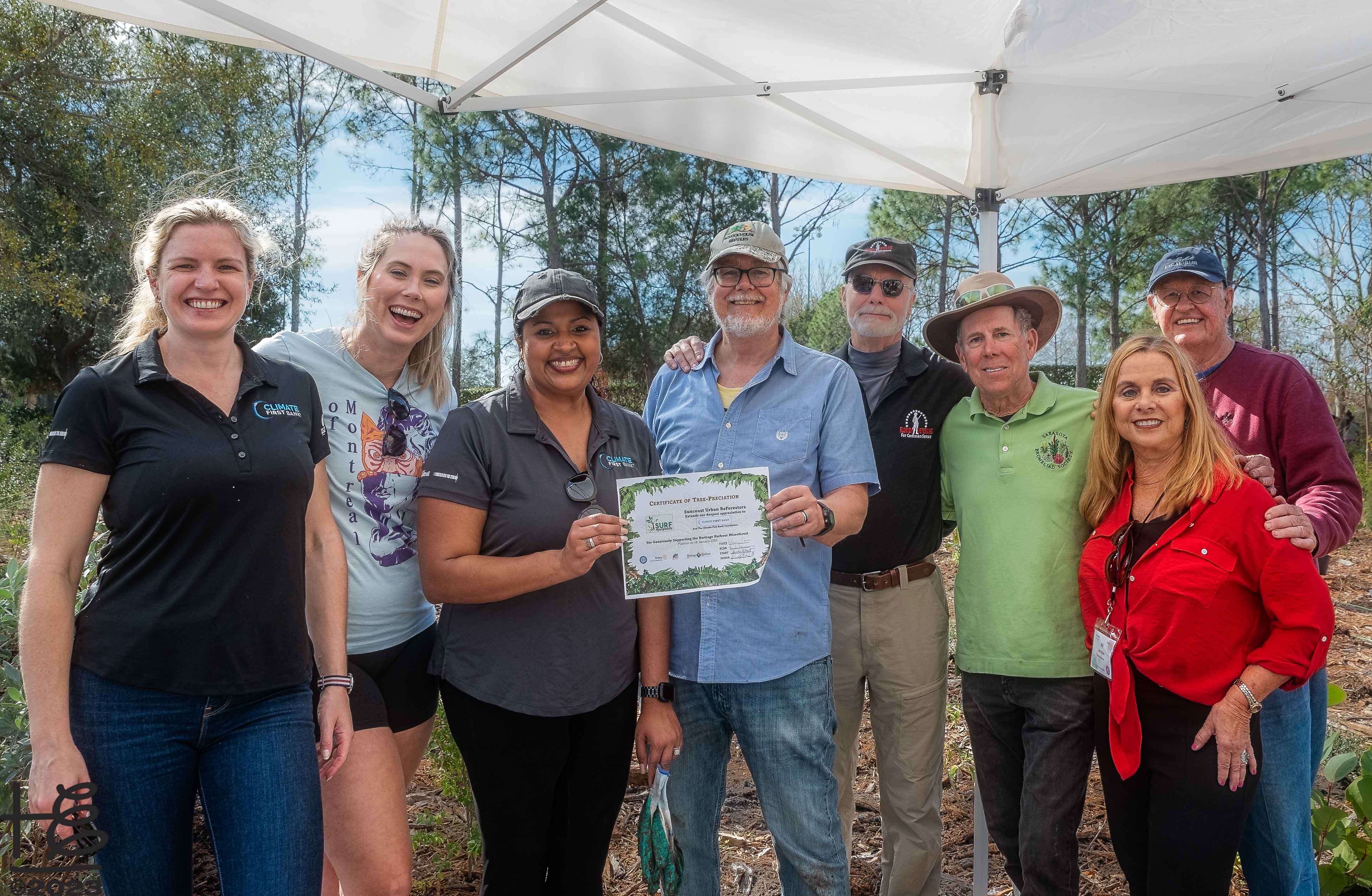
Charles honors Climate First at the Heritage
Harbor Microforest Planting, Sandy is in the back.
photo courtesy of Holly Elmore Images
Randomized planting of native-tree saplings creates four layers: canopy tree, tree, sub-tree, and shrub; trees within each category are not planted next to each other.

Due to the dense planting and fast growth, microforests draw down carbon from the atmosphere into the soil, via photosynthesis, at a faster rate (10X) than traditional forests. Microforests have a cooling impact on and provide a natural oasis within urban environments. With indigenous trees and shrubs, microforests are a haven for urban wildlife via food, habitat, and refuge from buildings and impervious surfaces.

Founded by Charles, Suncoast Urban Reforesters (SURF) is a collaborative organization dedicated to installing a series of microforests on Florida's Central Gulf Coast. SURF operates within START's organization structure.

To date, SURF boasts the successful installation of five local microforests, ranging in size from a 1/4 of an acre to a full acre. Four additional microforests and two living walls are in the development stages.

SURF microforests focus on erosion control and stormwater abatement. As stormwater often contains contaminants including nitrogen-based fertilizers, stormwater abatement aids in the prevention of severe and costly red tide outbreaks. 

Tim plant tree saplings
photo courtesy of Holly Elmore Images
Red tide occurs when there is a higher-than-normal concentration of Karenia brevis, a microscopic algae, in the nearby Gulf of Mexico; Karenia brevis feeds on nitrogen, phosphorous and other pollutants. Thus, a microforest's absorption of stormwater prevents the flow of contaminated stormwater into waterways that eventually reach the Gulf of Mexico and helps to deter red tide outbreaks.

Tim works closely with Charles on the SURF microforests planning and development, Mary Anne routinely volunteers at microforest-planting days, and Holly serves as the official START/SURF photographer. Additionally, Holly mentors Zach Zildjian, Zach Zildjian Design Services owner, who designs the microforest footprint and oversees the tree-planting day.

The RiA article, Urban Afforestation: Food Forests and Microforests, introduces microforests and features the Heritage Harbor Microforest-planting day orchestrated by SURF; The Holly Elmore Images(HEI) Heritage Harbor Microforest Planting album gives a still-photo documentary of the event.

Save our Seabirds (SOS)
Via an Ei introduction, Charles and Aaron met at the SOS property to strategize on how to incorporate a microforest into the landscape designs. Though the microforest is a year to so away, Aaron is committed to rewilding the property via replacing invasive, non-native species with native plants.

Aaron & Charles 
photo courtesy of Holly Elmore Images
In May 2022, Holly introduced Aaron to Pam Callender of Lifelines who specializes in native-plant-landscape design. Funded by a Longboat Key Garden Club grant, Aaron contracted with Pam to design the transformation of an unsightly drainage ditch into a stormwater-demonstration garden. Native plants were selected for coastal properties and bird habitat. On February 28, 2023, Pam oversaw the installation of 360 plants (54 species) by volunteers and Aaron himself!

The RiA Magazine article, Ei Connections: Save our Seabirds | Lifelines, showcases the Ei Connection as well as the Lifelines drainage-ditch transformation; the HEI album, Save our Seabirds / Lifelines, provides a pictorial recap.

Ei Rewilding Urban Landscapes Pilots
When she returned to Sarasota, Florida, Holly dedicated her spacious approximately 8,500-square-foot yard to two rewilding pilots. The front-yard native-plant-landscape pilot provides habitat and food for local urban wildlife; the bountiful insect population is the base of the predator-prey hierarchy and supports a robust wildlife community. 

Charles strategizing with Zach & his team
in the backyard pilot.
photo courtesy of Holly Elmore Images
The backyard pilot follows permaculture-oriented-landscape (POL) practices with an emphasis on human-food-producing plants. Thus, the general rule for the backyard landscape: any non-native plants must produce human food and/or provide direct soil-ecosystem benefit.

While the front-yard landscape is strictly native plants and was installed over a two-day period, the backyard pilot is an evolutionary process. For nearly nine months, the backyard was permitted to return to its "wild state" with abundant plant diversity; a variety of happy insects frolicked in the knee-high grass infiltrated with flowering plants.

Beginning in early 2022, the backyard was slowly "tamed" with mulched paths, a banana-compost circle, a row of native-blueberry bushes under the roof dripline, a pollinator garden, a food forest, and a raised herb-garden area with sun protection. Once the invasive carrotwood tree was removed, the south-side yard was opened to ample sunshine and prepped for a vegetable, herb, and edible-flower garden.

Charles introduced Holly to Zach, who oversees the backyard pilot evolution, and continues to provide support and inspiration for the POL

The RiA article, Ei Rewilding Urban Landscapes Pilots, introduces the pilots; the Holly Elmore Images (HEI) Ei Rewilding Urban Landscapes Pilots album documents the pilots' progress in a series of photo galleries.

Soil & Water: the foundation of life
As the Unitarian Universalist Church Green Team Chair, Mary Anne invited Holly to speak at their November 2022 meeting. Zach joined Holly for the the Soil & Water: the foundation of life presentation and shared on POL including its environmental impact.

For an encore performance, Holly spoke solo at the ECO Democrats Manatee February meeting.

The RiA Magazine article, Soil & Water The Foundation of Life, recaps the presentation outline with more in-depth information; the PPT presentation is available for download at this link.

Table2Farms (T2F)
Within a year of each other, Bridgett and Holly moved to the Florida Central Gulf Coast, a mere hour from each other. Once reconnected, Bridgett invited Holly to join the T2F Team as the industry expert during the pre-funding stage. T2F is committed to scaling-up food waste-composting operations in small- to medium-sized cities across the nation.

T2F vision: to aggregate billions of dollars for compost infrastructure funds and establish hundreds of industrial composting facilities in cities across the United States.

Once T2F secures initial funding, Holly will spearhead a Scaling-Up Composting in Sarasota Pilot working with Sunshine Community Compost; the intention is to develop a replicable template for scaling a grassroots-composting system into an operation with a solid business model including ample capacity for growth.

The LG will support the pilot in various capacities.

Working Together
As showcased in this article, the LG members work closely together within a myriad of interfaces related to coastal-water quality. With tremendous synergies, the LG intends to create a research project that augments and scientifically substantiates an existing local endeavor. Potential funding sources include one of the local foundations focused on environmental concerns as well as a Land Economics Foundation grant.

The environmental Leadership Group continues to grow its membership and influence in the Sarasota coastal area. Stay tuned for updates on the progress and substantial impact.

__________________

Tax-deductible donations in any amount are greatly appreciated to support Ei's important work. 

DONATE HERE.

About Elemental Impact:
Elemental Impact (Ei) is a 501(c)3 non-profit founded in 2010 as the home to the Zero Waste Zones, the forerunner in the nation for the commercial collection of food waste for compost. In June 2017, Ei announced the Era of Recycling Refinement was Mission Accomplished and entered the Era of Regeneration. Current focus areas include Nature PrevailsSoil Health | Regenerative Agriculture, and Water Use | Toxicity.

The Regeneration in ACTION Magazine articles, From Organic Certification to Regenerative Agriculture to Rewilding Landscapes: an evolution towards soil integrity and SOIL & WATER: the foundation of life, published to explain and substantiate the importance of Ei’s rewilding urban landscapes work within the Nature Prevails focus area.

The Holly Elmore Images Rewilding Urban Landscapes-album folder documents two active pilots: the Native-Plant Landscape Pilot and the Backyard Permaculture-Oriented Pilot.

MISSION:
To work with industry leaders to create best regenerative operating practices where the entire value-chain benefits, including corporate bottom lines, communities, and the environment. Through education and collaboration, establish best practices as standard practices.

Ei’s tagline – Regeneration in ACTION – is the foundation for Ei endeavors.

The following mantra is at the core of Ei work:

Ei is a creator, an incubator.
Ei determines what could be done that is not being done and gets it done.
Ei brings the possible out of impossible.
Ei identifies pioneers and creates heroes.

For additional information, contact Holly Elmore at 404-510-9336 | holly@elementalimpact.org

About Lambda Alpha International:
Lambda Alpha International (LAI) is an honorary society for the advancement of land economics. LAI provides a forum for the study and advancement of land economics where the "winnowing and sifting" of ideas takes place in an atmosphere of mutual respect.

LAI operates through a network of chapters. A LAI Chapter provides a variety of programs and forums for its members to share information critical to understanding important land-use issues. The IMPACT Blog article, Lambda Alpha International Atlanta Chapter: growing membership, influence and impact, introduces LAI along with its history and designated purposes.

In December 2013 Ei Founder Holly Elmore was inducted into membership and served on the LAI Atlanta Chapter Board until returning to Florida in 2021.  As the International Assistant Communications Director, Holly serves on the LAI Global Executive Committee.