Search This Blog

Friday, January 24, 2014

Airborne Kitchen Grease: a simple solution to a costly kitchen by-product

Airborne Kitchen Grease is a by-product
of culinary operations
Elemental Impact's definition of waste expands beyond material | by-products generated in operations to include resources, specifically water. In the ZWA Blog post, Zero WATER Waste: more than a goal, a necessity, the foundation for Ei’s Water Use | Toxicity Platform is established.

In alignment with an Ei mantra:  Ei determines what could be done that is not being done and gets it done, the Ei Team explores areas of significant corporate water consumption where technologies exist to reduce or eliminate water usage. Equipment investment must be offset by water and other cost-savings with a reasonable ROI – return on investment.

The initial focus is on water reduction in areas where the “spent water” released into sewer systems or other waterways is laden with toxic chemicals. Thus, water use and toxicity are addressed in unison. Airborne Kitchen Grease (AKG) is a perfect starting point for Water Use | Toxicity initiatives.

ATL Airport concessionaire mgr
Kyle Mastin learning about AKG
Airborne grease and smoke generated as a by-product of kitchen operations are a fire hazard, an environmental concern and costly to clean. Local and national regulations require commercial foodservice operations to install a kitchen exhaust system to evacuate heat, grease effluent, moisture and smoke from the cooking area. Generally consisting of a hood, baffle filters, ducts and exhaust fan, the kitchen exhaust system must be monitored and maintained in accordance with the codes.

Most kitchen exhaust systems are inspected monthly or quarterly and require a system cleaning due to grease build-up. On average an exhaust system cleaning uses approximately 350 gallons of water along with toxic cleaning agents. In addition, the metal baffle filters are generally cleaned nightly, requiring labor, water and toxic cleaning chemicals. On average 40 gallons of water is used for nightly baffle filter cleaning.

Ei Partner Ellis Fibre (EF) manufactures a patented, disposable grease filter that is placed in front of the baffle filters. EF's Grease Lock Filters (GLF) collect 90% plus of the kitchen grease particulates before entering the kitchen exhaust system. By eliminating grease build-up in the system, the nightly baffle filter cleaning is generally reduced to weekly; the number of third party contracted kitchen exhaust system cleanings are often required annually, down from monthly or quarterly.


Installed Grease Lock Filter system
For details on the GLF system, visit the ZWA Blog article, GREASE: a new frontier filled with economic & environmental promise .

To maximize impact, Ei is developing a city-wide AKG initiative. Addressing four key areas is the first step in template creation:
  1. Fire Safety
  2. Cost-Savings
  3. Metrics Platform
  4. Filter End-of-Life
Fire Safety:
First and foremost is fire safety. Before GLF approached Ei, fire safety was thoroughly addressed. Made from a patented, proprietary-blend of sheep's wool and other natural fibers, the filter is naturally oil absorbent and flame resistant. The filter composition allows GLF to keep the grease out of the hood and increase restaurant fire safety.

Certified to UL Standard 1046, GLF will not support combustion. Grease collected on the filter may flare-off if excessively heated or subjected to flames; however, when the flame source is removed the filter will self-extinguish and is replaced with a new filter.

GLF is tested, compliant and/or recognized by the following:
Grease accumulation in the
kitchen exhaust system
  • Standard UL 1046/ULC-S649 & UL 710 – Flame Exposure & Abnormal Flare-Up Test
  • NFPA 96 / IFC – Ventilation Control & Fire Protection of Commercial Cooking Operations
  • NSF 2 / ANSI 51 – Food Equipment & Materials-Formulation Review (Sanitation/Toxicology)
  • TYCO – World Leader In Fire Suppression Systems
  • IMC/UMC - Protects Public Health & Safety For All Building Ventilation Design
With fire safety addressed, the next step is to ensure GLF improves a foodservice operator's bottom line.

Cost-Savings:
To substantiate and quantify the water, labor and toxic chemical savings, Ei joined forces with Compliance Solutions International for a three-restaurant, eight-week GLF system pilot. The Water, Chemical, & Cost Savings in Commercial Kitchens By Using Grease Lock Filters, A Report on Restaurant Pilots prepared by Jay Parikh, CSI president is downloadable on the Ei Airborne Kitchen Grease page.

GLF | HMSHost Team day
before the GLF installation
The comprehensive report documents the impressive water, chemical and labor savings experienced by the participating restaurants. In each case, the restaurant’s bottom line improved by using GLF due to reduced cleaning of the baffle filters and the entire kitchen exhaust system.

In addition to the documented labor, water and chemical savings in the report, the facility experiences reduced fire risk and repairs & maintenance due to less grease accumulation within the exhaust system and the roof ventilation area. The community benefits from reduced emissions due to fewer full-exhaust system cleanings by a third party who travels to the kitchen.

Metrics Platform:
Program success is substantiated by quantifiable data. For the GLF system, measurable success is multi-faceted for the foodservice operator, building owner and the community. 

The foodservice operator experiences cost-savings from reduced third party full-system cleanings, labor for baffle filter cleaning, and water usage. Easily quantified, GLF is building a metrics collection platform that calculates and presents the savings in a simple format for the operator.

In addition to single-operator reports, the platform aggregates savings by companies, territories or whatever other filters are added to the system. The intention is to also track the tremendous water savings for a metro area. 

Later template stages will incorporate roof repair & maintenance savings, lower carbon emission from fewer truck miles driven for cleanings, reduced toxic cleaning agents sent to the sewer systems, and improved community air quality due to reduced grease particulates released into the atmosphere from the exhaust system.

Filter End of Life:
Grease-laden filter next to
new filter
GLF is working with Ei Strategic Ally the Institute for Local Self-Reliance on testing the filters for compostability. Current industry standards | certifications for compostability are designed for foodservice packaging, not filters made primarily of sheep's wool. Based on preliminary trials at composting facilities along with an ingredient review, GLF is confident the filters will meet the yet-to-be-determined compostability tests.

The grease collected by the filters is a potential valuable GLF system by-product. In the next months, extraction tests will determine the value compared with the effort required to remove grease from filters as a usable commodity.

With a scenario where all parties benefit - foodservice operator, facility owners, communities and the environment - Ei is developing a strategic plan for a metro-wide GLF installation. Atlanta is the template pilot city.

SFCI Team @ ATL Airport
As the Sustainable Food Court Initiative Airport Pilot, the Atlanta Airport takes a leading role with a potential campus-wide GLF installation. Ei Partner HMSHost participated in the above reference pilot with Pei Wei in the Atlanta Airport International Terminal. Impressed with GLF performance, HMSHost installed the system in additional Atlanta Airport locations.

An Atlanta Airport campus-wide GLF installation is estimated to reduce water usage by 1.1 million gallons per year and on average save each concessionaire $7,500 per year.  

For GLF installation pictorial recaps at the Atlanta Airport, see the Ei FB albums, 02-20-13 Grease Lock Filter Pilot Tour and 04-17-13 SFCI Team Tour - ATL Airport Int'l Concourse.

Airborne Kitchen Grease is a new frontier in sustainability. Water usage reduction is the first quantifiable step followed by eliminating significant amounts of toxic cleaning agents from entering the sewer system. Final steps address the airborne grease particulates not dispersed into the atmosphere, impacting air quality.

ZWA Blog articles will chronicle action taken, success achieved and how challenges evolve into lessons learned. Within frontiers, pioneers develop the most effective paths and create new standard practices. Kudos to the Atlanta Airport and HMSHost for taking the leadership role as Airborne Kitchen Grease pioneers!

Sunday, January 12, 2014

Refining Recycling Practices at the GA Dome

As the Sustainable Food Court Initiative Event Venue Pilot, the Georgia Dome is committed to refining existing recycling practices. In their role as a Founding Zero Waste Zones Participant the Dome built a strong recycling foundation when the program launched in February 2009. Working with the SFCI Team, the Dome is exploring avenues to refine existing practices that increase recycling rates and maximize material value generated at events.

In September Elemental Impact founder Holly Elmore joined Tim Trefzer, Georgia World Congress Center Authority director of sustainability, on a game day recycling tour with the new Falcons Stadium architects. It was an inspiring day to witness solid recycling practices in-place along with opportunities for program evolution. The ZWA Blog article, Winning Recycling Seasons Require Team Work, is recap of the game day tour.

Beginning with the 2012 season, Ei Partner Novelis stepped into the Falcons Recycling Partner role. First action steps included installing two brightly decorated eight-yard recycling dumpsters in the four GWCCA-owned parking lots used as pre-game tailgating venues. For the 2013 season Novelis provided outdoor & indoor recycling bins. The Novelis bins complement the Coca-Cola bins in service for the past years.


SFCI Co-Chair Doug Kunnemann,
Melissa Selem (Ei) & Matt
Bedingfield (Novelis)@ dumpste
With much of the proverbial "low hanging fruit" addressed, the SFCI Team is in a fact finding mode to understand the next best steps on the Recycling Refinement journey. Three areas of exploration include: 1> increased tailgating recycling with a focus on privately owned lots, 2> post-game food waste & compostable products picked from the Dome seating for composting destination and 3> creation of an on-site mini-MRF (materials recovery facility) where recyclable items generated are baled for sale as a raw manufacturing material.

On Sunday, November 10 SFCI Team members toured pre-game festivities on Falcons Landing and tailgating in private and GWCCA-owned parking lots. Since the September visit, the Dome added recycling bag dispensers on the Novelis dumpsters. Most folks are happy to participate in recycling, as long as it is easy!


It appears little to no recycling is in-place at the privately owned tailgate lots. Under Keep Mecklenburg County Beautiful executive director Jake Wilson's direction, the Carolina Panthers tailgate recycling program is a huge success. With the tailgate lots privately owned, Jake orchestrated an outstanding team consisting of public & private entities working in unison towards the common recycling goal. Jake is happy to share his expertise with the SFCI Team; a goal is to replicate the Panther's model for the privately owned lots near the GA Dome. The ZWA Blog article, Panthers Winning Recycling Season, is an overview of the successful program.  

Ei has a strong Charlotte presence and works closely with Jake on many fronts. The IMPACT Blog article, Charlotte Ei Partner Tours, along with the ZWA Blog articles, Bring the Possible out of Impossible, and Scaling Up Composting in Charlotte, NC, document Ei's on-going work in the Charlotte area.


Falcons Game Tour Group
see Ei FB album for names
When complete with the pre-game observation and fact finding mission, the Team walked the GA Dome back & front-of-houses noting the recycling practices in-place. Tim educated the group on current systems along with potential near-term upgrades. Although there are ample recycling bins, strategic placement may be enhanced in several areas including the executive level. 

Recycling bins placed next to trash cans in general yielded a reasonably clean stream. Yet the trash cans often contained PET and aluminum bottles. Additional signage that complements the Dome decor may improve recycling rates.

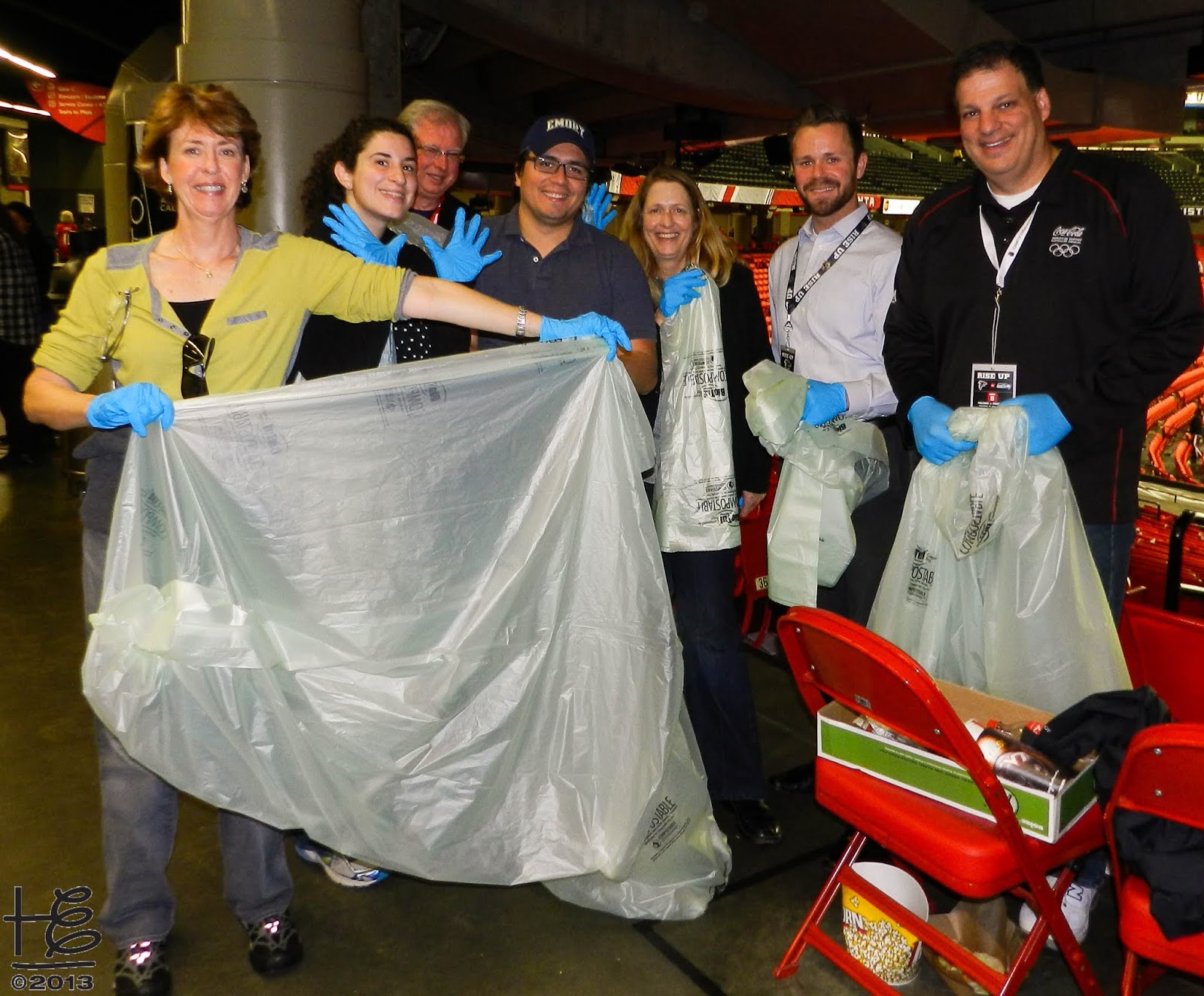
As the game ended several additional SFCI Team members joined the group to pick selected seating sections of food waste and compostable products fans left behind. The group collected 13 bags - 133 pounds of food waste & compostable products - and gained insight for creating a successful post-consumer food waste collection program.


SFCI Team members ready to collect
post-game f&b packaging
Ei Partner Heritage Bag donated a case of their BioTuf Compostable Bags for the food waste & compostable packaging collection. The bags were sturdy and perfect for the job at hand.

Insights during the "bowl picking" included:
  • Though the majority of the food and beverage packaging is compostable, there is more "trash" packaging than anticipated. Condiment containers | wrappers and subcontractor vendor packaging were the majority of contaminants for compost facility destination.
  • Most of the compostable food boxes | trays included a liner - there is confusion whether the liner is compostable.
  • The majority of the collected material was packaging and the bags were bulky, rather than the dense nature of pre-consumer food waste. On average the bags weighed around ten pounds when full.
Doug & Holly collecting bags
for delivery Wilbros
The food waste and compostable packaging bags were stored in the GA Dome loading dock. On Tuesday November 12 Doug Kunnemann, SFCI Co-Chair, and Holly met Tim at the Dome loading dock to transport the food waste bags to the Wilbros Organics & Biofuels food waste composting facility in Toccoa, GA. The Wilbros folks agreed to monitor the decomposition of the food waste bags, take pictures during the process and report results to Ei. Upon delivery, the Dome material was placed at a windrow end for easy monitoring.

According to Keaton Thompson, Wilbros compost operations manager, the food waste, packaging and bags immediately began the decomposition process, reaching 138 degrees within 72 hours. Ten days later the windrow temperature reached 146 degrees and decomposition was clearly visible. By December 3 the Dome material was well on its way to transforming into valuable, nutrient-rich compost.

Current bowl picking practices include collecting PET and aluminum bottles in a blue recycling bag with the remainder of the material collected in a black trash bag. The blue bags are placed in the recycling compactor for transport to Waste Pro's local MRF where the material is separated, baled and sold in the commodities market.

Pratt Tour Group
Each Falcons game approximately 35,000 programs and 140,000 promotional flyers are distributed among the seats. The majority of the valuable fiber is landfill destined. Ei Partner Pratt Industries operates a cardboard mill within 20 miles of the Dome where cardboard is made from 100% recycled material. In June 2013 Ei hosted a Pratt Mill Tour for Tim and Michael Cheyne, Atlanta Airport director of asset management and sustainability, to learn about the local option for paper | fiber generated at their respective facilities.  Note the Atlanta Airport is the SFCI Airport Pilot.

Novelis Tour Group
Within the vision of on-site source-separation is selling recyclable items as a raw material to local manufacturing operations. The Novelis aluminum recycling plant located in Greensboro, GA is another local option for valuable material generated at Dome events. In early October 2013 Tim and Holly toured the Greensboro plant to experience the aluminum recycling process.

For a pictorial recap of the GA Dome's pioneering efforts in Recycling Refinement, visit the Ei FB album, Refining Falcons' Recycling Programs.

Integral to Recycling Integrity - maintaining maximum material value with minimal energy expended - is on-site source separation and local material destination. The GA Dome along with its sister facilities the GA World Congress Center and Centennial Olympic Park are in the initial steps of refining their recycling practices to a program that maximizes material value, uses minimum energy and improves the bottom line.

Thursday, January 9, 2014

Plastic-Film Recycling: A New Frontier

A common Ei phrase is: "Ei determines what could be done that is not being done and gets it done." Embarking on a metro-wide plastic film recycling template pilot epitomizes the phrase. 

For most corporate entities, single-stream recycling is the only recycling option available for materials and by-products generated during operations. Although a valuable commodity, plastic film is a contaminant in single-stream recycling. The film wraps around machinery, often causing costly sorting delays.


Large plastic film generators compact the material into standard bales weighing 750 pounds to 1,000 pounds. For Piazza Produce, plastic film rebates rival corrugated cardboard as the top revenue producing material at their zero waste facility in Indianapolis. To learn about Piazza Produce's impressive zero waste program created by facility manager Scott Lutocka read the ZWA Blog articles, Zero Waste is a Team Sport and Source Separation Key to Maximum Recycling Profits.

Plastic film recycling among moderate generators is a frontier where infrastructure must be developed, within the company and the community. Many moderate generators use a sixty inch downstroke baler for their corrugated cardboard baling. When using the large baler for plastic film, the company must accumulate 750 plus pounds of plastic film for one bale. The logistics and space requirements to aggregate the film is not practical for most smaller producers.

Ei Team poses in front of a
GWCC plastic film filled container
The Georgia World Congress Center Authority, consisting of the Ga Dome (home to the Atlanta Falcons), Olympic Centennial Park (20 acre park commemorating the 1996 Atlanta Summer Olympics) and the Ga World Congress Center (fourth largest convention center in the nation), is a moderate plastic film generator. 

Several years ago GWCCA director of sustainability Tim Trefzer experimented with baling plastic film generated at the complex. After one large bale, Tim understood the benefits did not justify the required logistics.

Small balers play a vital role in aggregating plastic film for collection where moderate amounts are generated. Depending on the type of plastic, small balers produce easy-to-manage 100 to 200 pound bales. 

milk jugs in baler
@ ATL Airport
Elemental Impact first began working with Orwak small balers when Ei Partner HMSHost embarked on a milk jug recycling program at their Atlanta Airport Starbucks locations. On average the milk jug bales weigh 60+ pounds. HMSHost found the rebates from selling used milk jugs in the commodity market offset the baler and labor cost inherent within the program. The ZWA Blog post, Milk Jugs Recycled at Atlanta Airport, is an overview of the successful program launch.  Note the Atlanta Airport is the Sustainable Food Court Initiative Airport Pilot.

Next on the agenda was tackling plastic film recycling via internal company programs using on-site small balers. In 2011 Simon Property Group - the nation's largest mall and commercial real estate owner - joined the Ei Partner Program to develop zero waste practices at their malls, with a focus on plastic film and food wasteSynchronistic with Ei and Simon joining forces, the garment industry shifted from bulk retail packaging to individual packages in clear plastic film. RESULT: increased landfill tipping fees from the tremendous increase in tenant-produced plastic film.

In August 2012 Concord Mills, the SFCI Mall Pilot, launched their successful plastic film recycling program using an Orwak mini baler. The film rebates, coupled with reduced landfill tipping fees, cover the baler and labor cost and improve the bottom line. The ZWA Blog post, ACTION: Theme for SFCI Shopping Mall Pilot, announces the mall plastic film recycling program.

bagged plastic film ready for
baling @ Concord Mills
With single-location plastic film recycling success, Ei embarked on creating a city-wide plastic film recycling template pilot. Using lessons learned from the Zero Waste Zones 2009 launch, Ei understood how to develop a moderate generator network that results in route density and sufficient film quantity to sell material by the tractor trailer load. Thus, pilot pioneers share in the higher market value for volume sales. The small baler is a necessary template component.

In simple terms, the city-wide game plan is to recruit 10 - 12 industry pioneers who generate a moderate amount of plastic film in their operations. Using a small baler, the pioneers collect and bale plastic film on-site for periodic collection. A local hauler collects and delivers the small bales to a warehouse. The small bales are re-baled into standard size larger bales and stored in an empty tractor trailer. Once full, the plastic film is sold by the tractor trailer load as a raw material to a plastic bag manufacturer. Atlanta serves as the pilot city for the plastic film recycling template.

The ZWA Blog post, If it was easy, it would already be done, announces the city-wide template along with listing the inherent challenges within the groundbreaking program.

First meeting @ FreshPoint
introducing the pilot
Pilot pioneers are critical pilot team members. Working closely with the Ei Partners, the pioneers develop the internal systems necessary to collect the plastic film produced at their facility. Creative solutions to the operational and other challenges are integral to template development. Top management buy-in as well as employee engagement are required ingredients for success.

FreshPoint of Atlanta is the template founding pioneer. Owned by Sysco, FreshPoint is the nation's largest produce distributor with a strong sustainability commitment. As an early ZWZ Participant, FreshPoint has strong sustainability practices in-place and is eager to forge new recycling frontiers. 

Delivery of the Orwak baler
for the trial period
Ei Partner Orwak offered a complimentary small baler during the pilot trial period. On October 15 the baler was delivered to FreshPoint's Atlanta distribution center. The Ei Team was on-site to unveil the baler, survey plastic film collected and assist with making the first bale.  

While going through the collected plastic film, the team realized there was a significant amount of colored film that required a separate bale to maintain maximum material value.  A fun surprise was the disposable plastic aprons used in FreshPoint's produce cut shop were recyclable in the colored bales.

Shrink wrap securing produce boxes on pallets for customer delivery is one of FreshPoint's largest plastic film types generated. Prior to the pilot, the delivery labels were placed on the pallet after secured in shrink wrap. The labels are contamination for plastic film recycling. New procedures call for placing labels on the boxes prior to securing them with the shrink wrap. A simple procedure shift eliminated contamination.

Stuart Herman w/ Orwak
removing first plastic film bale
In the beginning the FreshPoint bales weighed roughly 60 pounds, less than half of the anticipated 150 - 200 pound bale. At Concord Mills, the bales average 175 pounds. Working with the FreshPoint associates on baling techniques, the bales now average 100 pounds. The remaining weight difference is due to the type of films generated at a mall versus a distribution center. Producing highly compacted bales is essential to maximizing the rebate revenue.

For the template pilot, Ei intends to invite 10-12 pioneers to join the plastic film recycling team. The GWCCA, Georgia Institute of Technology and the Atlanta Airport were invited and are exploring the feasibility of invitation acceptance. On November 6, Tim Trefzer with the GWCC and Liza Milagro, Atlanta Airport senior sustainability planner, visited FreshPoint's distribution center to understand the ease of collecting and baling plastic film in an industrial setting. In late December Ei founder Holly Elmore and Lorraine White of M-Pass met with Cindy Jackson, GA Tech waste & recycling director, and her team to introduce the plastic film recycling template pilot.

In addition to inviting pioneers, a next pilot step is to identify a recycling center location where the mini bales are re-baled into standard sized bales and stored in a tractor trailer until sold. In December Holly and Lorraine met at the U.S. Penitentiary - Atlanta with the local UNICOR folks to determine if synergies aligned to provide the recycling center facility and labor. As a second step in the evaluation process, Holly met with federal UNICOR associates in Washington D.C. later in the month.

Lorraine White with local
UNICOR folks @ ATL Penitentiary
UNICOR is the federal prison system employment arm. The ZWA blog article, Prisons: Valuable Resource for Recycling Refinement Systems?!, introduces the potential synergies for partnering with prison systems, along with outlining Ei's relationship with UNICOR and TRICOR, the Tennessee prison system employment arm.

Determining the types of plastic film produced among the various generators in a metro area is another action point within the template development. The goal is to invite a broad cross section of generators - distribution centers, hotels, airport, event | convention facilities, malls - to understand first-hand the types and quantities of plastic film produced in an urban district. Working with Ei Partner Hilex Polyan industry leading manufacturer of plastic bag and film products, the pilot team will balance the labor required to separate plastic film type versus the material value. The intent is for Hilex Poly to purchase the plastic film by the tractor trailer load as a raw material for their manufacturing process.

Documentation is integral in template development, especially when the long-term intentions are to duplicate the program across the nation and expand source-separated material collection beyond plastic film to the components in single-stream recycling. The Ei FB album, Plastic Film Recycling: building a city-wide network, published as a comprehensive pictorial recap of the action to date in the city-wide plastic film recycling template pilot. The album is structured so it will accumulate the pictorial story as the template is built.

Ei Chair Scott Seydel
filming Preston Fletcher w/ FP
In late November the Ei film crew visited FreshPoint's distribution center for a morning of taping the plastic film recycling procedures in action. Timed with the Annual Ei Partner Meeting, executives from FreshPoint, Hilex Poly, Orwak, M-Pass and the U.S. Zero Waste Business Council joined the film crew for interviews on their role in creating a city-wide plastic film recycling template grounded in solid business sense. The EiPlastic Film Recovery Pilot @ FreshPoint video is the first version edited from FreshPoint's perspective.

ACTION is underway in this monumental template development. By creating new in-house practices and community infrastructure, the city-wide plastic film recycling template is staged to evolve corporate recycling options beyond single-stream. The pioneers are gathering to forge pathways into the a new recycling frontier. Stay tuned!!!

Monday, December 16, 2013

Tackling the Challenges | Barriers to Sustainable Packaging

2013 Partial Group Picture
(Ei FB album lists names)
In December Ei orchestrates the Annual Sustainable Food & Beverage Packaging Value Chain Meeting where the challenges | obstacles to sustainable packaging are addressed. Global Green hosts the important meeting at their D.C. offices. Meeting invites are extended to the trade associations and non-profits who operate within the F&B packaging value chain.


Each year the meeting discussions exemplify the shifts and growth in an evolving industry. The ZWA Blog article, Second Annual F&B Packaging Meeting, is an overview of the 2012 meeting. For a recap of the inaugural 2011 meeting, visit the ZWA Blog article, Sustainable Foodservice Packaging Meeting.

Anchoring the value chain organizations are the following participating trade associations:

Numerous non-profits who work in arenas impacting food & beverage packaging attended the meeting:
Pre-meeting dinner
(Ei FB album lists names)
Many meeting participants joined Ei Chair Scott Seydel for a pre-meeting dinner at Logan Tavern. Great food and lively, fun dinner conversation set the stage for the powerful meeting the following day.

In the morning, each organization presented on their mission, stakeholders, 2013 activities and finished with planned 2014 projects. The meeting agenda, PPT presentations and attendee list are available for download on the Ei Meetings & Events page. 

Lack of consistency and confusion within the value chain was a consistent challenge interwoven within presentations. To create common ground several organizations are in various development stages for packaging standards, tool kits and other educational mediums. These documents are designed to assist the entire value chain - from manufacturers to foodservice operators to recycling and composting facilities - with decision making that aligns with emerging best sustainable packaging practices.

Linda Chipperfield presenting
Green Seal
Completed documents include Green Seal Standard #35, Foodservice Packaging, NRA Recycling Tool Kit, and  ILSR | Ei Compostable Foodservice Ware Packet prepared for the SFCI - Atlanta AirportThe USCC received a grant for a Compostable Plastics Tool Kit and the request for proposals is issued for 2104 work. Noting a frequent disconnect between packaging designers and effective end results, the SPC lists a Design Guide for Foodservice Packaging as 2014 projected work.

Industry working groups are another common thread among the participating organizations. In 2012 FPI formed the Paper Recovery Alliance and Plastic Recovery Group, which work on parallel yet complementary paths.The NRA formed the ConServe Sustainability Advisory Council comprised of environmental leaders from 14 restaurant and food service businesses spanning the value chain. Several Ei Partners and Advisers serve on the NRA Council. In 2013, the SPC created the Foodservice Packaging Leadership Committee focused on recovery.

Understanding the flow of packaging during the recovery process was a focus area for CoRR and FPI in 2013 and continuing into 2014. Working with the American Chemistry Council, the Association of Post-Consumer Plastics Recyclers, the Carton Council and the National Association for PET Container Resources, FPI is interviewing 50+ MRFs - material recovery facilities - to benchmark current foodservice packaging recovery including final destinations. Within the boundaries of proprietary agreements, FPI intends to share the results with industry counterparts.

 Bryan Vickers of the GPI
during his presentation
Green Seal is in the midst of the GS Pilot Standard for Sustainable Chicago Restaurants development with the final revised Standard due for publication in February 2014. As of December 11, six restaurants are certified under the new Standard. The NRA is relaunching the NEW Zero Waste Zones in Atlanta following the program purchase from Ei in late 2012.

During her presentation, Brenda Platt with ILSR | SBC made an astute observation: End of USE is the appropriate term versus the common End of LIFE used in the industry. The ZWA Blog article, Perpetual Life Cycle Systems - Simplicity is Key, further discusses Brenda's comment.

With updates and presentations complete, the meeting segued into a powerful industry strategy session focused on the challenges | barriers to sustainable packaging. As participants are well-acquainted from prior meetings and industry events, the group discussion was candid, honest, respectful and geared towards common goals. 

Lynn Dyer of FPI presenting
Strategy session topics flowed into several subject matters: Recyclable vs. Compostable vs Reusable, Policies & Regulations, Contamination, Best Practices, End Markets, Outreach | Education and Working Together | Collaboration. 

Food contamination is a major obstacle for recyclable food & beverage packaging and gives strong support for compostable options. In recent curbside research, FPI found food waste contamination at acceptable levels for most recycling operations. The group will continue research, observation and dialogue throughout the year on the topic. A 2014 goal is a common industry voice for the recyclable vs. compostable choice. Most participants agree reusable food & beverage serviceware are preferable when practical. 

Overall the group supports public policy and regulations mandating recycling and food waste diversion from the landfill. A sufficient grace period is important for infrastructure development. In addition to public laws, the group is in favor of contractual provisions between landlords | facility managers and service contractors | tenants that require action necessary for successful zero waste programs. Janitorial contract provisions specifying collection services that minimize contamination and maximize material value is a high priority.

Anne Bedarf with the
SPC during strategy session
Independent third party certification is important for developing programs; the group supports BPI Compostable Packaging Certification as the industry standard for compostable packaging. Packaging labels to assist the consumer with desired disposition was a strong discussion point. The SPC takes a leading role in labeling with their How2Recycle label initiative, which is up to 21 participants.

A group goal is industry best practices development. Diverse end markets and infrastructure in various locals is a challenge to standard packaging templates and best practices creation. The general consensus is program development must be at the local level yet based on an existing  broad sustainable packaging foundation. The SPC Essentials of Sustainable Packaging educational workshop offers a comprehensive introduction to sustainability considerations that apply to the entire packaging life cycle: material sourcing, packaging design, manufacturing, transport, and final disposal.

Ei Administrator Melissa Selem
documenting the discussions
Strong end markets, whether recycling or composting, are the driving force for successful packaging programs. Though there were few specific discussion points on end markets, Lynn Dyer with FPI pointed out the entire session was dedicated to creating a valuable packaging End of Use, whether recycling or composting destined. The other topics are the building blocks for strong end market development.

In many circumstances sustainable packaging is more expensive than existing packaging and increases costs for food & beverage departments within a large facility or tenants in an event venue, office building, mall or other facility. Yet the switch to sustainable packaging shifts the disposition from waste to a material, saving on compactor pull charges and landfill tipping fees. In general, reduced materials management fees are realized by the facilities department or venue landlord |  management company. 

Lily Kelly of Global Green
during strategy session
There was discussion on the disparity between those incurring the increased packaging cost and those benefiting from the disposition cost-savings. Unless required by contract or lease provisions, most food & beverage departments or outlets do not incur the additional expense without sharing in the disposition savings. An equalizing of the costs | benefits within the value chain is required for sustainable packaging to emerge as standard packaging.

Throughout the discussions, synergies among various programs and initiatives were apparent and the respective organizations made a point to further discuss working together, if not doing so already.  In addition to the Annual Meeting, the group decided a midsummer conference call is important to enhance communication and strengthen work-in-progress.

DC Eco-Warriors @ reception
(names in FB album)
Great food and fun are integral to Ei's successful meeting model. Thanks to Whole Foods catering, the group was treated to delicious, healthy food for a light breakfast, substantial lunch, dessert afternoon break, and importantly an ending wine reception. Compostable packaging was used and Melissa Selem, Ei Program Administrator, delivered the meeting food waste and packaging to Whole Foods for composting prior to the finale dinner.

For the meeting pictorial recap, visit the Ei FB album, 2013 F&B Packaging Value Chain Meeting.

An emerging industry in the evolution process, sustainable packaging is ready for best practices, tool kits, educational material and templates for the food and beverage industry to adopt and follow. The Annual Sustainable Food & Beverage Packaging Value Chain Meeting brings together the industry leaders who address the challenges | barriers to sustainable packaging becoming standard packaging. Stay tuned for exciting announcements as the industry continues to evolve!